Why the current debate on binders offers an opportunity to rethink printing inks, equipment and processes together
NC-Free Is Not Enough. Are We Thinking Far Enough Ahead in Packaging Printing?
von André Altevogt,
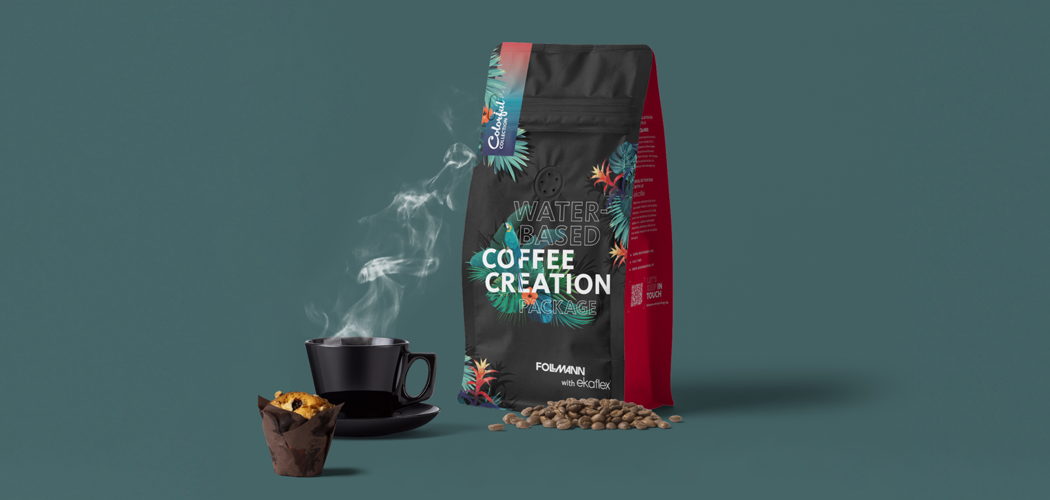
Coffee packaging printed using Follmann's water-based FOLCO-AQUAFLEX-Premium-L system: The careful coordination of binder chemistry, pigmentation and other formulation components enables sophisticated print results on suitably pretreated films.
(Source: Follmann)
The packaging printing industry is discussing the move away from nitrocellulose (NC) and the increased use of polyurethane (PU) binders. This is important. But are we overlooking a greater opportunity? If we are reassessing printing ink technologies anyway, why not also question the use of organic solvents?
NC-based printing inks have shaped modern flexographic and gravure printing for decades. It would be technically incorrect to question their performance across the board.
Anzeige
At the same time, the regulatory framework is changing. The European Packaging and Packaging Waste Regulation (PPWR) is increasing the pressure to design packaging for recyclability. In certain mechanical recycling processes, printing ink layers containing nitrocellulose can adversely affect the quality of recovered plastics. This does not amount to a general ban on NC. Rather, it means that we need to examine the suitability of ink systems more closely in conjunction with packaging structures and recycling processes.
The answer currently being discussed most frequently is NC-free printing inks based on polyurethane. This makes sense from a technical perspective. But if we are already prepared to fundamentally change the chemistry of our printing inks, why stop at the binder?
Perhaps We Are Simply Optimising the Next Intermediate Step
Polyurethane is versatile: its polymer structure allows properties such as adhesion, flexibility and resistance to be tailored to specific requirements. NC-free PU systems are therefore a sensible step for many applications. However, a large proportion of these systems remain solvent-based.
We are changing a key component of the printing ink while retaining the underlying system. Requirements relating to the handling of organic solvents, exhaust air treatment, emissions management and safety equipment therefore remain in place. This is not an argument for rejecting solvent-based printing inks altogether. For certain applications, they are still a technically and economically suitable choice today.
However, every technological transition requires time and investment: systems must be qualified, production parameters adjusted and approvals obtained. If we are undertaking this effort anyway, should we not also examine whether a more far-reaching step is possible? Why switch from solvent-based NC inks to solvent-based PU inks without seriously considering water-based PU systems as an alternative?
This question is long overdue. Not because water-based inks can cover every application, but because their capabilities today extend far beyond their former limitations.
Four Decades of Experience Are No Substitute for Asking New Questions
At Follmann, we made the decision to focus on water-based printing inks more than 40 years ago. Our approach is not a short-term response to the current debate surrounding NC. We produce exclusively water-based printing inks and have consistently focused our development activities on this technology. The journey has not always been easy. Particularly in flexible packaging printing, print quality, adhesion, drying, speed and downstream processing must work together reliably.
For printers, a successful trial alone is not enough. New systems must remain available after approval, deliver reproducible results and operate economically. For me, the ability to innovate and reliability of supply go hand in hand.
At Follmann, a key difference begins even before the actual ink formulation: we develop and manufacture our own binders. This allows us to tailor the polymer chemistry and raw material composition specifically to substrates, adhesion, flexibility, film formation and downstream processing requirements, rather than relying exclusively on externally available standard binders.
In-house production also strengthens our reliability of supply. We control a central part of the value chain ourselves, reduce our dependence on external binder suppliers and can monitor quality and formulation consistency more closely. This does not make us independent of chemical raw materials. But it gives us greater flexibility – both in development and in supplying our customers.
250 Metres per Minute: What Matters Is Industrial Performance
When I talk to printers about water-based printing inks, the questions are usually very specific: Do they work on film? Can we achieve our production speeds? What about adhesion, colour brilliance and fine halftone screens? And will the printed material subsequently meet the requirements for lamination?
These are the right questions. After all, what matters is not the theoretical potential of a technology, but its performance under practical production conditions.
With our water-based FOLCO systems, we develop solutions for applications including suitably pretreated PE, PP and PET films. The interaction between binder chemistry, pigmentation and other formulation components makes it possible to achieve demanding print results. One example is the production of high-quality coffee packaging using our FOLCO-AQUAFLEX-Premium-L system.
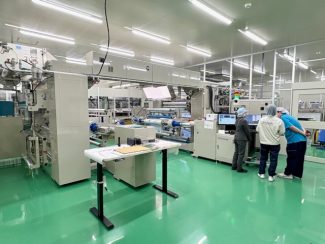
Continuing the dialogue: Follmann is planning webinars and other activities focusing on water-based PU printing inks in 2027. Topics will include potential applications, processing and economic viability, as well as differences compared with NC-based and solvent-based PU systems. (Source: Follmann) (Bild: Foto 2025 von www.ChristianSchwier.de)
In this application, sophisticated printed designs were produced at a production speed of 250 metres per minute. At the same time, the ink system met the requirements for subsequent lamination and further processing.
This does not prove that every printing company will achieve the same results on every press and substrate. However, it provides concrete evidence that water-based systems have long since moved beyond simple applications.
Practical examples like these change the debate. Instead of judging water-based inks by their former limitations, we should examine which applications can now be reliably managed on an industrial scale – and under what conditions.
We Need to Talk Less About Inks and More About Processes
A common mistake when introducing new technologies is to integrate a new product into an existing process and expect identical results under unchanged conditions. Technological change rarely works that way.
Water-based printing inks have different physical properties from solvent-based systems. Drying, in particular, places different demands on airflow, temperature and moisture removal.
The surface pretreatment of films, anilox roller configuration and ink management also influence the result. The key question is therefore not simply whether a new printing ink will run on an existing press. What matters is how the interaction between ink, substrate, machine and process parameters can be optimised.
This does not mean that switching to water-based systems necessarily requires an entirely new production line. It does mean, however, that existing processes do not automatically provide the optimum conditions for a different technology.
In some cases, targeted adjustments are sufficient. In others, drying capacity, press configuration or production workflows need to be examined more closely. The appropriate solution depends on the specific application.
The transition to water-based printing inks should therefore not be regarded as a simple product substitution. It offers an opportunity to question existing processes and develop them further through collaboration.
When ink manufacturers, machine builders, film producers and printers combine their expertise, solutions can emerge that go beyond optimising a single component.
This is where a significant opportunity lies: progress does not come from new formulations alone, but from a better understanding of the entire production process.
Sustainability Cannot Be Judged by the Ink Container Alone
The debate surrounding NC is largely driven by recyclability requirements. However, the environmental impact of packaging does not arise solely at the end of its life cycle. Manufacturing, drying, energy consumption and emissions must also be taken into account.
Water-based PU printing inks can offer additional options in this respect. Reduced use of organic solvents can lower VOC emissions during the printing process and – depending on the formulation and equipment technology – change the requirements for exhaust air treatment.
Equally important, however, are the limitations of this statement: water-based does not automatically mean recyclable. Nor is a water-based printing process necessarily more energy-efficient than a solvent-based one.
Evaporation, drying and the existing production equipment must all be considered. Anyone who takes sustainability seriously must assess the specific packaging solution and its entire manufacturing and end-of-life treatment process.
A future-proof printing ink must therefore do more than perform well on film. It must deliver throughout the entire process – technically, economically and in terms of sustainability objectives.
2027: A Year for New Questions
I believe that 2027 could be an important year for water-based printing inks in flexible packaging printing.
Not because solvent-based systems will disappear within a few months. Not because every printing company will suddenly be able to switch to water-based inks. But because the industry needs to reassess its technological decisions under changing conditions.
My intention is not to pit technologies against one another. It is about openly evaluating their industrial performance and economic implications.
If we reduce the NC debate to a simple change of binder, we may be missing out on significant innovation potential.
And that is why I would like to conclude with a question: If we were to redefine our printing ink technology today for the next ten years, would we choose the same path again?
Continuing the Dialogue
Follmann is planning a series of technical webinars on water-based PU printing inks for 2027. The focus will be on potential applications, differences compared with NC-based and solvent-based PU systems, as well as questions relating to processing and economic viability. Further information will follow.
André Altevogthas been Sales Director Packaging Solutions at Follmann since July 2024. He is responsible for the international sales of packaging solutions, with a particular focus on water-based printing inks. Previously, he spent more than 35 years at Bischof + Klein, where he served as Sales Manager for Industrial Packaging from 1999 onwards. He brings extensive experience in flexible plastic packaging to his current role.