Congratulations on the 70th anniversary of the ERA/GRA
von Ansgar Wessendorf,
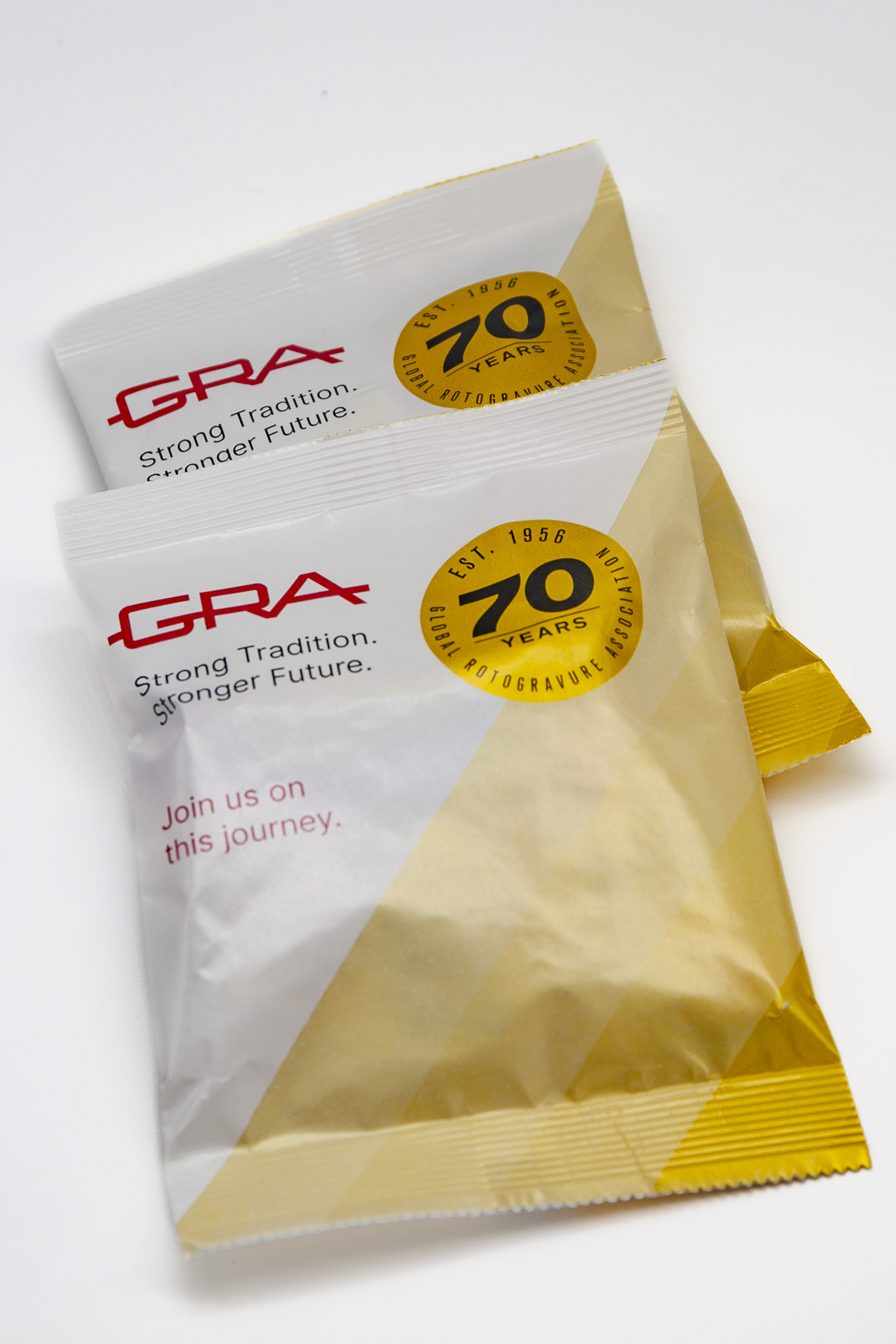
A tubular pouch to mark the 70th anniversary of GRA, designed, engraved, printed and packaged at the HdM Stuttgart (Source: HdM Stuttgart)(Photo Credit: Copyright: (C) R. Schaul - Stuttgart - 2012)
Over the 70 years of the ERA’s existence, gravure printing has undergone impressive development, becoming a leading process for the high-volume production of commercial print and, subsequently, the highest-quality process for producing flexible packaging and cigarette packets. A look through the archives reveals examples of sustained and consistent research: the development of electromechanical engraving, which began as early as the 1950s; the development of electrostatic printing assistance in the early 1960s; and investigations into paper web transport and web tension as early as the mid-1960s. These developments subsequently led to machine automation and automatic register control – years before these became priorities in other printing processes.
This cemented rotogravure’s leading position in terms of technology and quality right up until the beginning of the current century. No technological advantage lasts forever, and web offset in commercial printing and flexographic printing in packaging gradually caught up. With the advent of the internet and ever-decreasing print runs, the Achilles’ heel of gravure printing – the costly electroplating involved in printing cylinder production – became an increasingly pressing issue. However, this affects more than gravure printing alone; the entire printing industry has had to adapt and continues to do so. Advances in the automation of cylinder production have helped to achieve significant cost savings, whilst improvements in colour management and makeready have made shorter print runs economically viable. The members of the ERA have taken on all these challenges over the years and successfully overcome them.
Anzeige
Connecting university expertise with industrial practice
Ever since I took up the professorship in gravure printing at Hochschule der Medien Stuttgart (Stuttgart Media University) in 2009, the ERA has been my first port of call for establishing links with industry. One of my first business trips took me to the ERA technical meeting in Munich. The conferences and seminars have been invaluable opportunities to exchange ideas with experts and expand my knowledge.
Stuttgart Media University has always had a special connection with gravure printing, as evidenced, amongst other things, by the fact that for many years there were two professorships dedicated to the subject: one for cylinder making and one for the gravure printing process itself.
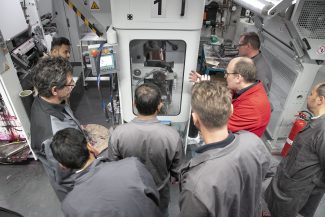
Hands on at the gravure printing press BOBST Rotomec MW60 (Source: HdM Stuttgart)
My predecessor, Prof. Dr Ulrich Reiser, launched the seminar ‘Tiefdruck zum Anfassen’ (‘Gravure at Your Fingertips’ in English) in 2006 in collaboration with the ERA. The ERA took charge of the organisation, whilst the university provided the premises and course content. This year, not only is the ERA celebrating its 70th anniversary, but ‘Gravure at Your Fingertips’ is also marking its 20th anniversary. Over this period, we have familiarised several hundred participants from industry with the entire gravure printing workflow, including cylinder making and printing.
Following more than ten years of sustained efforts and multiple applications, we were able to modernise our gravure printing workflow twelve years ago by installing a state-of-the-art four-colour gravure press from BOBST. This gave a significant boost to both the seminars and our cooperation with the gravure printing industry. We see ourselves as a partner to the industry, with a focus on training and a scientific approach that complements its practical expertise.
Although there is now only one professorship in gravure printing, we are the only university in Europe to operate a ‘Competence Centre Rotogravure’ covering the entire workflow, including cylinder production, data preparation, electromechanical engraving and printing, together with the necessary measurement technology and associated colour management. For some projects, we convert the printed substrate into tubular pouches or gift-wrapping paper. For example, we produced the ‘anniversary tubular pouch’ for the GRA anniversary.
Material development and changing global markets
With this expertise, we have supported the industry over the years in its transition to papers with a higher calcium carbonate content, in the development of ink formulations with more cost-effective components or superior performance characteristics, and in the pursuit of faster, more cost-effective production of printing formes without electroplating. The current focus is on paper with barrier properties as a substitute for polypropylene (PP) or polyethylene terephthalate (PET).
Unfortunately, commercial rotogravure printing is now, with a few exceptions, a thing of the past. Even the packaging gravure sector, which was thriving until just a few years ago, must face the fact that investment in Europe is now essentially limited to replacement projects, whilst the real momentum lies in Asian countries. There, however, remarkable growth rates can still be observed.
The ERA has also recognised this situation and, as a logical step, has renamed itself the ‘Global Rotogravure Association’ and established a global presence. I believe this was the right move. The challenges will remain, just as they have for the past 70 years. Yet the GRA is well equipped for the years and decades to come.