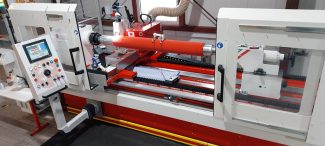
Comexi’s modular ML2 Evolution laminator is designed for a range of laminating and coating processes in flexible packaging production. Interchangeable application trolleys, automated settings and closed-loop coat-weight control are intended to simplify job changes. Comexi specifies a maximum production speed of 450 m/min.
The ML2 Evolution combines several coating and laminating technologies on a single machine platform. According to the manufacturer, the system can be configured in more than 1,000 variants. It is aimed at converters seeking to produce both high-volume standard lamination jobs and frequently changing coating applications on one line.
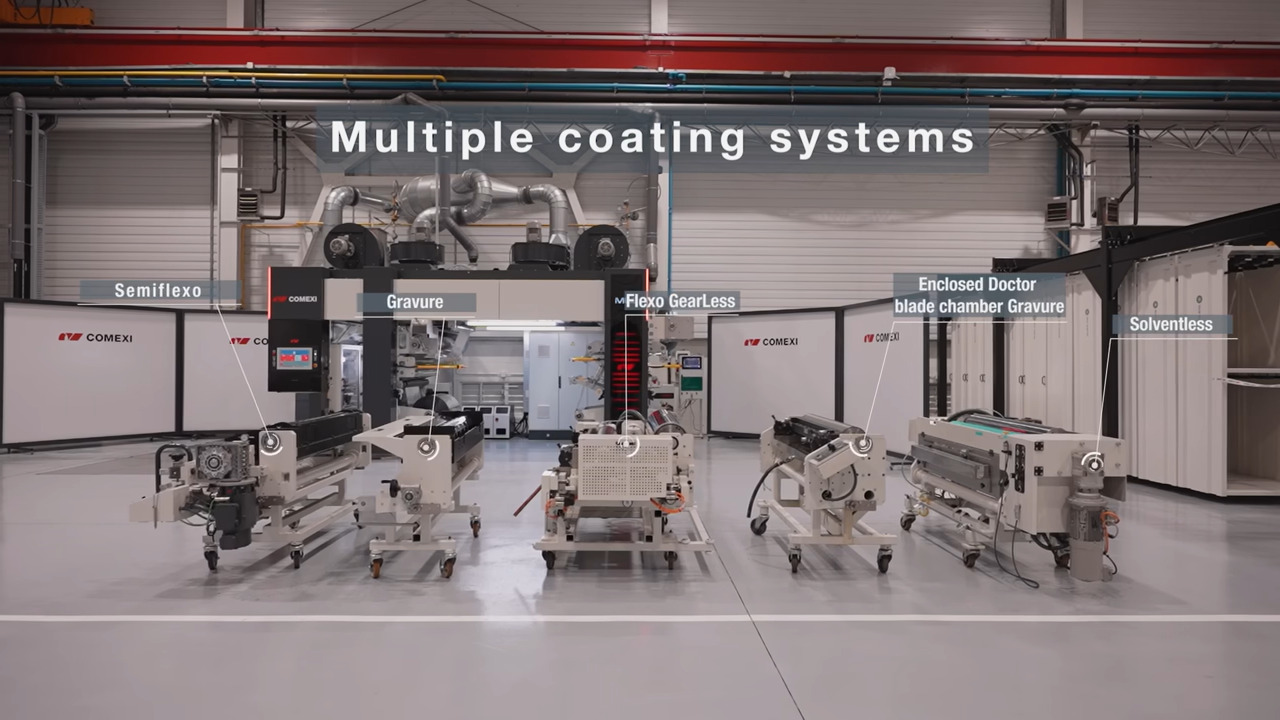
At the heart of the machine is a system of interchangeable application trolleys. Depending on the application, adhesive or coating medium and the required coat weight, the machine can be equipped with semi-flexo, gravure, gearless flexo, closed-chamber gravure or solventless application technology.
Application trolleys for different processes
The semi-flexo trolley is intended for full-surface coatings at higher coat weights. According to the manufacturer, the conventional gravure trolley can process both water- and solvent-based adhesives and coating media. The gearless flexo trolley operates without a mechanical gear train. The system is designed to apply uniform coating layers and enable rapid sleeve changes.
A closed-chamber gravure system with a doctor blade is also available for water-based coatings and higher coat weights. A dedicated application trolley meters adhesives for solventless lamination. Overall, Comexi states that the ML2 Evolution can process solvent-based, solventless, water-based and UV-curable adhesive systems.
The range of applications also includes cold-seal and heat-seal coatings. In addition to films, the machine can process paper-based materials. Comexi also offers triplex versions for three-ply laminates as well as customised machine configurations.
Automatic trolley changes reduce setup time
The application trolleys are coupled to the machine automatically, which is intended to accelerate changeovers between different application processes. Quick-change systems for sleeves and rollers are also available to operators.
The machine is controlled via an integrated Rexroth touchscreen system. Operators can load jobs and retrieve previously saved machine settings. External peripheral equipment can also be incorporated centrally into the job recipes. This is intended to eliminate the need to enter individual settings separately for repeat jobs.
According to the manufacturer, the user interface also includes operating tutorials. Additional features include a web-edge or web-guiding sensor and the cloud-based COOL online service, which provides support around the clock.
Closed-loop system monitors coat weight
For solventless applications, the ML2 Evolution features closed-loop coat-weight control. The system measures the coat weight during production and automatically adjusts it to the stored target value. Operator intervention is not intended to be necessary.
Real-time monitoring is integrated into the machine control system. This allows deviations in coat weight to be detected and corrected during production. Comexi does not, however, provide specific tolerance ranges or measurement accuracy figures.
For coatings applied in register, the machine features mark-to-mark register control. The system detects marks on the printed web, compares their position with the applied varnish or coating layer and corrects the register position. This allows coatings and varnishes to be positioned accurately in relation to an existing printed image.
Web tension from 20 to 500 newtons
The web-tension control system is designed for a range of substrates. According to the manufacturer, this includes films containing recycled material, whose mechanical properties may be subject to greater variation.
At the unwind, web tension can be set between 20 and 500 N. Comexi specifies a range of 30 to 500 N for the rewind. Automatic roll changing can be integrated at both the unwind and rewind.
Depending on the configuration, the maximum working width is 1,330 or 1,530 mm. The largest specified roll diameter is 1,000 mm, while the maximum roll weight is 1,500 kg. Configuration-dependent restrictions may apply to both figures.
Speeds of up to 450 metres per minute
Comexi specifies a maximum machine speed of 450 m/min. The speed achievable in production will, however, depend on the substrate, coating medium, coat weight and required drying capacity.
For water- and solvent-based applications, the ML2 Evolution can be fitted with a modular drying tunnel. This allows the drying section to be adapted to different production requirements. The machine also features a three-roller system and, according to the manufacturer, low-consumption drive motors.
Production data can be analysed via Comexi Cloud. The platform supports machine monitoring, the supervision of production jobs in progress and the analysis of performance indicators. Technical service functions are also integrated.
Technical data at a glance
| Feature |
Manufacturer’s specification |
| Maximum speed |
450 m/min |
| Maximum working width |
1,330 or 1,530 mm |
| Maximum roll diameter |
1,000 mm |
| Maximum roll weight |
1,500 kg |
| Web tension at unwind |
20 to 500 N |
| Web tension at rewind |
30 to 500 N |
| Adhesive systems |
Solvent-based, solventless, water-based and UV-curable |
| Additional applications |
Cold-seal and heat-seal coatings |
| Application technologies |
Semi-flexo, gravure, gearless flexo, closed-chamber gravure and solventless |
| Roll changes |
Automatic at unwind and rewind |
| Register control |
Mark-to-mark |
| Coat-weight control |
Closed-loop control for solventless applications |
| Drying |
Modular drying tunnel |
| Operation |
Rexroth touchscreen, recipe management and job presets |
| Connectivity |
Peripheral integration and Comexi Cloud |
| Special versions |
Triplex and customised configurations |
Assessment
The technical distinction of the ML2 Evolution lies less in any single new coating process than in the integration of different application technologies on one configurable platform. This may be relevant to converters whose job mix frequently alternates between standard lamination, functional coatings and multilayer laminates.
Whether this results in productivity gains at a particular production site will, however, depend on actual changeover times, the job mix, drying capacity and the materials being processed. The information currently available does not include comparative figures for setup time, waste, energy consumption or achievable coat-weight accuracy.