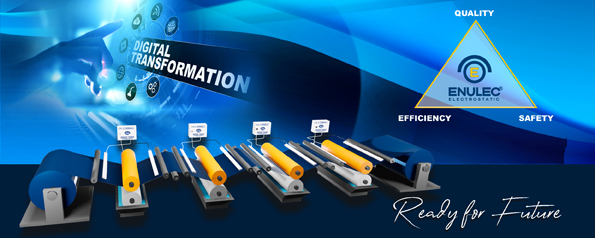
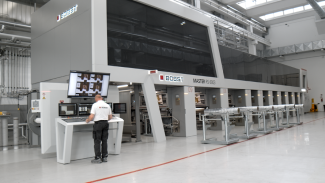
Recent advances in ESA technology extend beyond electric field control to digitalisation. ENULEC’s ESA and static elimination systems no longer operate as standalone units; they communicate directly with the main machine control system.
(Source: ENULEC)
As the Global Rotogravure Association (GRA) celebrates its 70th anniversary in 2026, the industry looks back on seven decades of technological development that have fundamentally transformed gravure printing. Few technologies have accompanied this evolution as consistently as electrostatic assist, or ESA. Although its contribution remains invisible in the finished product, ESA plays a significant role in print quality, process reliability and cost efficiency.
The GRA’s anniversary year also marks another milestone: ENULEC GmbH, based in Trittau near Hamburg, celebrates its 45th anniversary in 2026.
Anzeige
From a Student Placement to an International Supplier
The starting point was an observation rather than a business plan. During a student placement at an industrial company in the early 1980s, Hubertus Dettke encountered some of the problems affecting gravure production at the time: unreliable ink transfer and recurring fires in printing units caused by electrostatic charges. Countermeasures often consisted of improvised devices.
Drawing on this experience, he and his wife Christa began developing their first prototypes for electrostatic assist and safe charge dissipation in 1981. What started on a small scale, driven by personal initiative, grew over the following decades into an international supplier. Their son Christoph Dettke joined the management team in 2006, representing the second generation and taking particular responsibility for international sales. ENULEC remains a family-run business, with subsidiaries and partner companies around the world.
Why ESA Is Used in High-Quality Gravure Printing
The underlying physical challenge remains essentially the same as it was in the 1980s: ink must be transferred from the tiny engraved cells of a rotating gravure cylinder to the substrate as completely as possible and in precisely controlled quantities. If a cell fails to empty fully, the result is a missing dot or dot skip—a microscopic void that is particularly noticeable in halftones. ESA systems assist ink release by generating a precisely controlled electrostatic field between the gravure cylinder and the substrate. The aim is to maintain uniform ink transfer even as process conditions change.
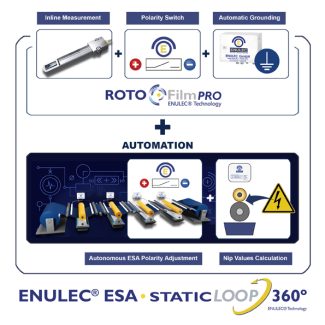
With its patented ESA Static Loop 360 system, ENULEC has developed a closed-loop control system for the continuous monitoring of electrostatic charges. The system measures static charges both on the web and in the printing nip, records these values during production, and automatically adjusts output and polarity. (Source: ENULEC)
The demands placed on this technology, however, have increased considerably. Modern gravure presses operate at speeds of between 600 and 900 m/min—several times those typically encountered when the company was founded. At the same time, the range of substrates has expanded significantly. In addition to paper and paperboard, the packaging industry now requires reliable print quality on films, laminates and functional barrier layers.
This material diversity presents a technical challenge for ESA systems. Each material occupies a particular position in the triboelectric series and therefore has a characteristic tendency to acquire a positive or negative charge through contact and separation. A fixed polarity setting cannot consequently be equally effective across all substrates and material combinations.
ENULEC addresses this challenge with patented polarity switching technology. According to the company, this allows the polarity of the electrostatic assist to be adjusted specifically to the triboelectric properties of the substrate. The technology is intended to maintain stable ink transfer as material combinations change.
Process Safety: A Second Dimension
Alongside print quality, safety was one of the original drivers behind the company’s development. It remains a central aspect of ESA technology today. Electrostatic charges pose risks ranging from spark discharges in solvent-containing, potentially explosive atmospheres to material damage caused by charges trapped within substrate rolls, which can complicate subsequent converting operations.
With its patented ESA Static Loop 360° system, ENULEC has developed a closed-loop control system for the continuous monitoring of electrostatic charges, incorporating four of its own patented technologies. The system measures static charges both on the web and in the printing nip, records these values during production, and automatically adjusts output and polarity.
This can reduce electrostatic charging by up to 70 per cent. A patented grounding mechanism provides additional controlled charge dissipation once a threshold of 2 kilovolts (kV) is reached. The Gravure AIMCAL Alliance recognised the development with an honourable mention in the “Technical Innovation – Press” category, highlighting its contribution to reducing ignition risks.
Automation and Digitalisation: ESA as a Source of Process Data
Recent advances in ESA technology extend beyond electric field control to digitalisation. Modern ESA and static elimination systems no longer operate as standalone units; they communicate directly and bidirectionally with the main machine control system. With Static Loop 360°, for example, the production machine, ESA system and IT application exchange information continuously. Relevant process data are captured, consolidated and analysed, enabling automated control that adapts independently to the material, machine and production environment.
This approach extends to other elements of ENULEC’s portfolio. The Inline Static Measurement System continuously measures electrostatic charges in real time—not only at the printing unit, but also at downstream stages such as winding and laminating. If readings exceed a defined threshold, the system sends a signal to the machine control system via a signal contact.
The ROTO-Green quality management system consolidates these data for process control, while the TRIPLE MASTER static elimination system coordinates static control throughout production and converting. Encrypted remote maintenance solutions complement these functions, helping to identify faults at an early stage and improve maintenance planning before machine stoppages and production losses occur.
The next stage of development involves closer integration of sensors, control algorithms and machine communication, moving towards systems that optimise production parameters proactively as well as correcting them reactively. ESA is thus evolving from a print quality tool into an automation component and a source of process data for the gravure press.
Market Development: Gravure in Transition
Gravure currently accounts for around a quarter of global packaging print production. Its principal applications include high-quality packaging, labels and decorative flexible packaging—segments that require consistent image quality throughout long production runs.
At the same time, the industry is working to reduce the resources consumed by the gravure process. Laser-engraved cylinders, reusable printing forms and automated, digitally monitored processes can reduce ink consumption, waste and downtime. ESA contributes by stabilising ink transfer, helping to prevent print defects and thereby reduce the consumption of ink, energy and substrate.
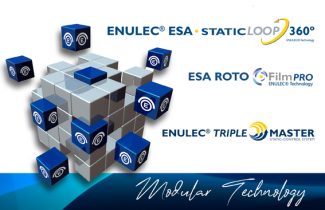
The ENULEC system comprises ESA Static Loop 360 for charge control, the Inline Static Measurement System for real-time measurement, ROTO-Green for consolidating process data, TRIPLE MASTER for static elimination, and encrypted remote maintenance. (Source: ENULEC)
ENULEC attributes its position as a leading global supplier in part to the manufacturer-independent integration of its ESA systems. Its solutions can be incorporated into different control architectures regardless of the press manufacturer. These include full integration with the machine control systems of the three major European gravure press manufacturers.
This independence is particularly relevant to international printing companies operating mixed press fleets. It can allow ESA systems to be deployed across different machine platforms, with measured values, warnings and control variables incorporated into each machine’s operating and safety logic.
Conclusion
Over 45 years and two generations, an idea conceived in a workshop to address specific print quality problems and fire risks has grown into a leading global supplier. In the process, ENULEC has developed ESA from electrostatic field assistance into an intelligent automation component driven by process data.
Where mechanical precision was the primary determinant 70 years ago, process data, materials expertise and automation now also shape quality, safety and cost efficiency in gravure printing. ESA remains an important part of the process—one that has helped shape this transformation for decades and will continue to advance it.