The impression roller as a process factor in gravure printing
von Ansgar Wessendorf,
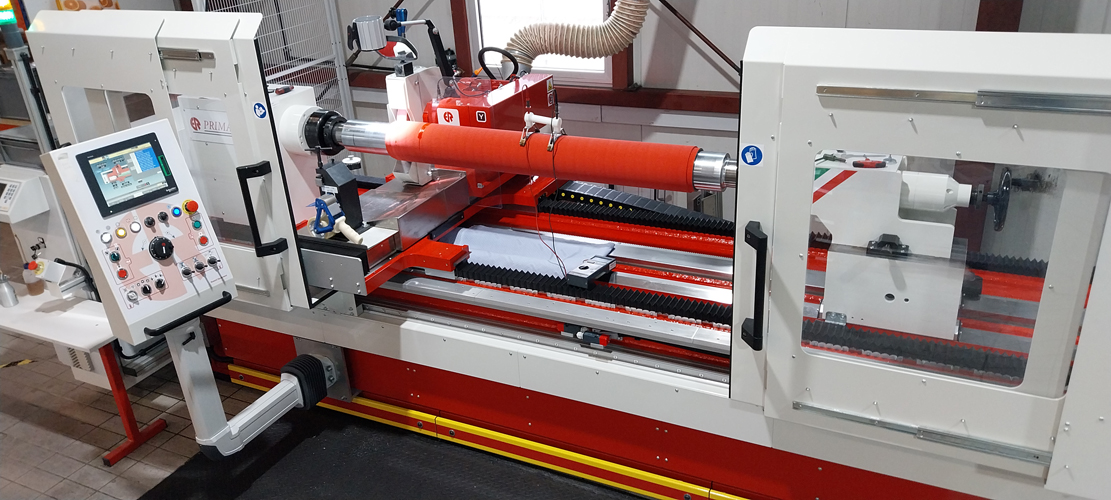
Rossini’s Prima machine for sleeves and rollers enables the turning and precision grinding of rubber coverings, as well as the machining of shoulders and end faces. (Source: Rossini)
At the interface between the printing cylinder and the substrate, the impression roller influences ink transfer, register and web handling on a gravure press. The Italian company Rossini supplies roller and sleeve systems tailored to different substrates and operating loads.
Gravure printing is based on a simple principle: the web contacts the printing cylinder and picks up ink from its engraved cells. Whether this contact is uniform across the full web width depends to a considerable extent on the impression roller. This backing roller establishes mechanical contact between the substrate and the printing forme and guides the paper, board or film web through the printing nip. It therefore influences ink density, image reproduction, register, web handling and production stability.
Anzeige
The contact zone is critical
The impression roller comprises a supporting roller or sleeve system with an elastomer or polymer covering. This covering must accommodate irregularities in the substrate without deforming uncontrollably under line load, heat or high rotational speeds. If it is too soft, the nip contact band widens, increasing cyclic deformation and heat generation. An excessively hard impression roller, by contrast, is less effective at compensating for surface roughness and variations in thickness.
The decisive factor is therefore a well-defined nip contact band across the full working width, rather than the highest possible impression pressure. Ideally, the contact zone is rectangular, with the same width at both ends. Its geometry is nevertheless influenced by covering hardness, impression roller diameter, cylinder width and line load. Deflection also increases with working width. A wide working width combined with a small diameter and high impression pressure presents a particularly demanding configuration.
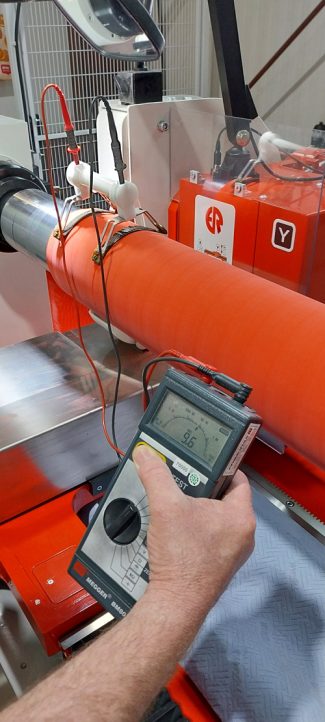
Users should regularly check the resistance values of ESA and conductive impression rollers. (Source: Rossini)
The impression roller’s rotational accuracy and dimensional stability have a direct effect on print quality. Even small deviations can cause density variations, vibration or web movement. If heat, swelling or mechanical loading changes its effective circumference, slip, web tension and register may also vary. Precise geometry and stable dynamic behaviour are therefore essential.
The covering should absorb shocks without exciting resonances. Deformation and friction also generate heat. Permissible temperature limits vary with the material and design. The maximum temperature resistance stated in a data sheet represents a material limit; it is not necessarily the recommended continuous operating temperature on a gravure press.
The demands increase as press speed rises. Acceleration, braking, job changes and long production runs must not alter the impression roller’s geometry. A periodic runout error that is barely noticeable at low speed can cause vibration and register or density variations in high-performance operation. Consistent performance throughout the service life is therefore crucial.
“The impression roller must not be considered in isolation. Its geometry, covering and mechanical design must be compatible with the substrate, speed and other process parameters. Only then will the contact zone remain stable across the full working width, including during long production runs and repeat jobs,” explains Sonja Haesen-Bauschulte, Managing Director of Rossini Germany.
Chemistry electrical properties and service life
The ink and cleaning regime must also be considered in the mechanical design. Solvents can cause rubber coverings to swell or change their Shore hardness. This can alter the diameter, surface condition, electrical resistance and nip contact band. Cleaning should therefore use the recommended solvent in moderate quantities. To prevent ink from adhering to the impression roller, its covering should be relieved outside the print width. This also benefits ink transfer.
With electrostatic assist (ESA), an electric field supports ink transfer from the engraved cells. This is particularly relevant when printing on films and on absorbent or textured substrates. The volume resistance, dynamic resistance and insulation characteristics of the impression roller covering must match the specific ESA configuration. Direct charging, top loading and core charging impose different requirements. Rossini designs the electrical properties to meet the specifications of the respective ESA system supplier.
Service life involves more than abrasion resistance alone. Hardness, rotational accuracy, geometry and electrical properties must also remain within the specified limits. Users should regularly check the resistance values of ESA or conductive impression rollers. This is essential to ensure that the impression roller fulfils its function in terms of both quality and safety.
It is important to recognise that the surface resistance of ESA impression rollers is temperature-dependent and may increase or decrease as temperature rises. Rossini’s ESA impression rollers have a negative temperature coefficient. The rubber compound is therefore formulated to provide sufficiently high surface resistance at room temperature and to prevent it from falling below the critical value of 1 MΩ at operating temperature. Below this value, the risk of a fire in the printing unit increases.
Regrinding can restore the impression roller’s surface. However, this requires a sufficiently thick covering and precise grinding equipment. Rossini specifies a covering thickness of 10–20 mm, with at least 8 mm remaining after grinding.
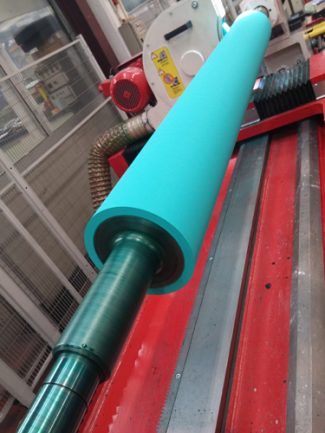
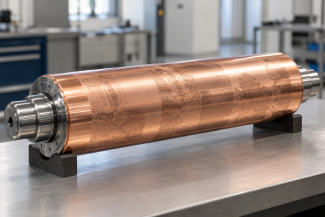
FocA rubber-covered roller after high-precision surface grinding. (Source: Rossini)usArea=111111111
From family business to system supplier
Founded by Erminio Rossini in 1928, the company is now managed by the third generation. Rossini identifies several milestones in its development: the tapered Speedwell system patented in 1978, the carrier sleeve with a carbon-fibre-reinforced polymer (CFRP) surface developed for flexographic printing in 1995, and the RED ESA sleeve developed in 2011. Rossini is the world market leader in industrial sleeve technology and operates eight production sites and three sales offices. Its range includes sleeves and air mandrels for gravure printing and laminating, components for flexographic and heatset offset printing, and machines for machining rollers and sleeves. This breadth of systems is relevant to gravure printing: a precision covering alone is insufficient if the air mandrel, mounting procedure or regrinding compromises the geometry.
Speedwell taper compressed air and flexural rigidity
The Speedwell principle combines a tapered air mandrel with a matching impression sleeve. The sleeve’s inner shell is made from conductive or non-conductive glass fibre using the filament-winding process. Compressed air assists mounting. Once mounted, the impression sleeve fits securely on the taper. Serial numbers and colour coding help identify and match sleeves. For demanding applications, Rossini offers the deflection-compensating Speedwell “Antiarco” air mandrel. It is intended to provide the necessary rigidity where high impression pressure, wide print widths and small diameters coincide. The taper-ground surface is chrome- or nickel-plated. Rossini specifies a mounting air pressure of 12–20 bar and a flow rate of 10 normal litres per minute for the mandrel.
The sleeve can be changed without replacing the supporting mandrel, reducing makeready times on a gravure press. Different coverings or hardness grades can also be held in stock for the same press configuration.
A sleeve can be inspected, ground or replaced off press while the air mandrel remains in the gravure press. Machining uses a grinding mandrel with shorter journals than those of the press mandrel. Clean tapered mating surfaces, an adequate compressed-air supply for mounting and unambiguous sleeve identification are essential. Dirty or damaged mating surfaces impair repeatability.
Three impression roller coverings for different applications
The black, red and green ESA versions differ in more than colour. Each uses a different material designed for specific applications.
Black ESA Rubber H – Formula 1 has an elastomer covering for ESA applications using solvent-based inks and higher impression pressures. The specification lists a hardness of 70–90 Shore A, a maximum line load of 20 kg per linear centimetre and temperature resistance up to 150°C. It is specified as resistant to alcohols, water, ozone, acetate contents of up to 30% and methyl ethyl ketone (MEK) contents of up to 20%. For cleaning, Rossini specifies a mixture of 75% ethanol and 25% ethyl acetate.
Red ESA is intended for film and paper substrates and solvent-based inks. According to the manufacturer, its red elastomer covering avoids the ionisation effect that can occur with conventional black rubber compounds containing carbon black. Rossini lists it as an ATEX-certified version with the marking Ex II 2G IIA T4 for use in Zone 1. The specification gives a hardness range of 75–90 Shore A, a maximum line load of 15 kg per linear centimetre and temperature resistance up to 150°C. Rossini likewise recommends a mixture of 75% ethanol and 25% ethyl acetate for cleaning.
Green ESA PU has a polymer covering that Rossini calls Electrolast PU. It is suitable for printing on paper and board at high line loads. Its principal application is cigarette printing, where high line loads and small impression roller diameters produce a more concentrated pressure distribution. It is intended for water-, alcohol- or acetate-based inks with an acetate content no greater than 30%. The specification gives a hardness of 80–95 Shore A, a maximum line load of 50 kg per linear centimetre and temperature resistance up to 90°C. Rossini lists resistance to petroleum spirit, water, isocyanates and ozone. For cleaning, the manufacturer recommends petroleum spirit or a mixture of 80% ethanol and 20% ethyl acetate. Green ESA PU therefore has a different temperature and solvent operating window from the black and red versions.
All three coverings are available as rollers or Speedwell sleeves. According to Rossini, roller diameters range from 35 to 550 mm, with lengths of 150–5,000 mm. For sleeves, the manufacturer specifies diameters of 80–450 mm and lengths of 350–3,500 mm.
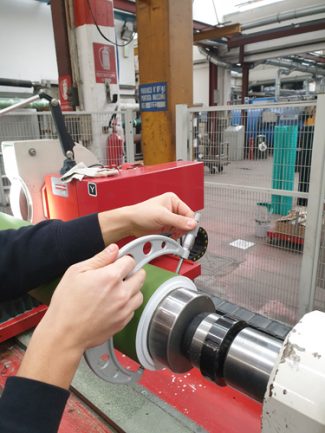
Measuring the diameter of a rubber roller. (Source: Rossini)
Hardness is a process decision
The available hardness ranges vary by covering and application. Within these ranges, however, the selection cannot be based on the substrate alone. Web surface texture and thickness, press speed, ink chemistry, line load and the printed image also influence the result. Technical guideline values therefore cannot replace application-specific trials. Shore hardness is part of process optimisation rather than an isolated product parameter. The covering width and the geometry of the edge regions must also suit the application. On ESA impression rollers, the relieved edge regions are also safety-critical: unsuitable geometries can produce an adverse concentration of the electric field at the edges. The ESA system supplier’s specifications and the charging method must therefore be taken into account in design and machining.
More than three coloured sleeves
The gravure portfolio also includes antistatic impression roller coverings. Neopress G Stat is designed for acetate-, alcohol- and MEK-based inks, as well as inks containing up to 20% toluene. The covering is used predominantly for conductive impression rollers in gravure printing. Rossini specifies a hardness of 50–90 Shore A and a maximum line load of 25 kg per linear centimetre. Neopress C Stat is suitable for water- and alcohol-based inks. Its specified hardness is 60–90 Shore A, with a maximum line load of 40 kg per linear centimetre. It is also used in gravure printing, particularly at higher line loads, although its main applications are laminating machines and lay-on rollers in winders.
Rossini specifies an electrical resistance below 1 MΩ for both versions. These antistatic coverings perform a different electrical function from ESA impression rollers.
Other gravure versions include Neopress B-BH Red, Neopress PU, Neopress PU Stat and Viton. The range also includes rollers for specialised applications, such as the Roto Flow inking roller. Of particular relevance is the ability to specify conductivity, hardness, material, core construction and surface finish for the individual application.
Depending on the version, Rossini’s Prima machine for sleeves and rollers enables the turning and precision grinding of rubber coverings, as well as the machining of shoulders and end faces. For the PLC version, Rossini lists parallel, tapered and trapezoidal profiles, convex or concave crowns, and stepped contours. Stored parameters can be recalled for repeat jobs. Storage systems keep the pressroom organised and protect sleeve geometry and surfaces.
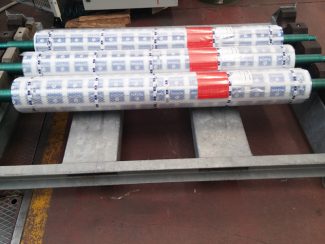
After production and comprehensive quality inspection, the packed gravure impression rollers are ready for dispatch. (Source: Rossini)
Selection determines print quality
There is no universally optimal gravure impression roller. Selection depends on the substrate, ink, cleaning agent, working width, line load, speed and ESA system. These factors determine the hardness, electrical design, sleeve concept and finishing requirements. Only when they are properly coordinated can the printing process remain stable over long production runs.
In practice, however, the role of the gravure impression roller is often underestimated. To reduce costs, impression sleeves are sometimes re-covered with rubber several times or selected primarily on price. According to Rossini, repeated re-covering of ESA impression rollers can compromise safety and degrade the quality of the inner shell. The company therefore does not re-cover ESA sleeves. In addition, many printing companies do not regularly check conductivity and resistance values. These checks are nevertheless necessary to assess an impression roller’s quality and safety condition.
Conclusion
In addition to its role in ink transfer, the gravure impression roller performs a safety-critical function when solvent-based inks are used. If its electrical resistance values do not meet the requirements of the electrostatic assist (ESA) system, static charge cannot be reliably dissipated. A high electrostatic charge can also build up on the impression roller when printing a substrate without ESA. In both cases, the risk of a fire in the printing unit increases.
Rossini’s gravure portfolio includes ESA elastomers, PU coverings for high loads, specialised conductive versions, air mandrels with high flexural rigidity and the corresponding grinding technology. These components must be matched to one another to ensure a safe and stable printing process.
Rossini rollers sleeves and equipment for printing and converting
What began as a workshop in Milan’s Navigli district in 1928 is now an international specialist in rollers, sleeves and equipment for printing and converting processes. Erminio Rossini laid the foundations of the family business.
From 1950, production shifted from leather to rubber rollers. The company’s international development began with Felice Rossini’s arrival in 1958 and the addition of rubber-covered rollers for flexographic and gravure printing in 1965.
Rossini manufactures rubber rollers and sleeves at its headquarters in Rescaldina, near Milan. Nearby, its Equipment division also produces grinding machines, cleaning systems, impression cylinders, and storage systems for adapters and sleeves.
Technical milestones include the Speedwell sleeve system for gravure printing and laminating, patented in 1978, and the adapter sleeve for flexographic printing, introduced in 1995. Further developments include the ATEX-certified ESA-RED sleeve, the green Polycoat rubber covering for sleeves and rollers used in solventless laminating, and the Leonardo sleeve for web offset printing. The Fast Bridge Adapter for flexographic printing received the FTA Technical Innovation Award in 2025.
Rossini is currently working on developments including Eco Grav, a polymer coating intended as an alternative to copper and chromium for gravure cylinders, and a 3D flexographic printing sleeve.
Research and development remain a focus of Rossini’s corporate strategy. The company operates eight production sites in Europe, the Americas and Asia. In addition to Italy, it has a presence in Germany, Spain, Romania, the USA, Brazil and India. Its decentralised structure is intended to keep delivery distances short and provide service close to its customers.
The Milan workshop has thus developed into a global family business combining materials development, precision manufacturing and automation for modern printing and converting processes.