From a European technical forum to a global industry association
Global Rotogravure Association: 70 years serving gravure printing
von Ansgar Wessendorf,
The Global Rotogravure Association is celebrating its 70th anniversary. Founded in 1956 by Western European publication gravure printers, it now represents an international value chain centred on packaging and decorative printing. Its development illustrates the close relationship between technological progress, standardisation, regulation and knowledge transfer in gravure printing.
An association evolving with its printing process
The name is new; the association is not. The former European Rotogravure Association (ERA) adopted the name Global Rotogravure Association (GRA) only in 2025. The change reflects a development that unfolded over many years: a European representative body for publication gravure printing has become an international network whose main focus now lies in packaging and decorative printing.
Anzeige
When the association was founded in 1956, magazines, catalogues and other high-volume printed products defined the gravure market. The process combined high production speeds with reproducible quality, but required substantial investment and a precisely coordinated production chain. Accordingly, the founders viewed the association primarily as a forum for technical exchange.
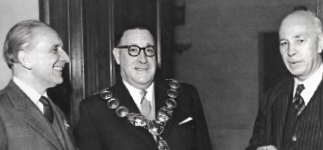
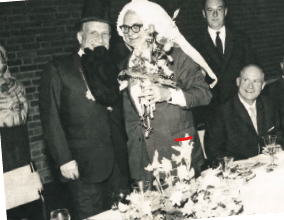
The ERA met in Watford, England, in April 1959. From left: Dr W. Matuschke, the Mayor of Watford and C. R. Greenhill. (Source: GRA)
British publication gravure printer Sun Printers was among the founding members. Its company history records the first ERA meeting as taking place on 31 January 1957 in Zofingen, Switzerland. From then on, technical issues were to be discussed collectively at a European level, rather than solely between individual companies.
Technology as common ground
In the early decades, the focus was on quality assurance, process knowledge and gravure printing formes. Patent documents from the 1970s list the ERA as the applicant for methods of inspecting cells in gravure cylinders and producing printing formes using an energy beam. For a time, the association thus contributed directly to collaborative development work.
In 1985, the association’s board appointed a working group of executives from member companies to examine the competitiveness of gravure and web offset printing. The resulting study analysed cost structures, raw materials, customer relationships and the criteria governing the choice of printing process. Two decades later, the study was updated at the Royal Institute of Technology in Stockholm. In doing so, the association established a role that remains important today: bringing together sensitive industry data to build an overall picture of the market.
Rainer Geiger, Director Strategic Business Unit Converters at Janoschka Holding, describes the importance of this work for members: “We have been members of the GRA for decades and continually benefit from valuable market insights and a lively exchange with industry partners. The conferences and technical workshops organised by the GRA provide regular market information and opportunities for us to contribute actively.”
From publication to packaging gravure
Packaging gravure grew in importance during the 1960s and 1970s. Manufacturers of flexible packaging needed consistent quality, including on long runs and demanding substrates. At the same time, decorative gravure printing for furniture surfaces, flooring and wallpaper was expanding. Packaging and decorative printers, along with suppliers of cylinders, machinery, inks, substrates and other technologies, joined the original group of publication gravure printers.
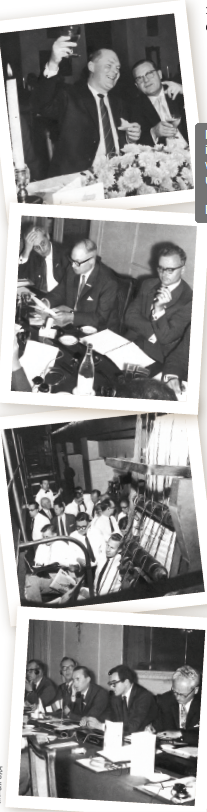
The ERA in its early years: celebrations, conferences, machinery demonstrations and resolutions were already part of association life. (Source: GRA)
The GRA thus developed into an association representing the entire process chain. Print results are influenced by numerous factors: data and engraving, cylinder surfaces, inks, substrates and doctor blades, as well as drying and press settings. Improvements therefore need to be discussed in the context of the complete workflow.
Giannis Giannakopoulos, Plant Manager at Hatzopoulos, says: “GRA membership connects our company with the international gravure community and encourages continuous learning, innovation and shared growth. Personal contact with suppliers and peer companies enables a direct exchange of ideas and best practices. This supports ongoing improvement and the industry’s collective progress.”
As print runs declined and media became increasingly digital, European publication gravure capacity subsequently contracted. The GRA continued to represent this segment while broadening the scope of its work. Packaging and decorative printing became central pillars, joined by security printing and technical applications. The association’s history therefore also reflects the shifting balance within gravure printing.
Knowledge transfer becomes part of the infrastructure
The exchange of knowledge continued, but its formats evolved. The annual International Gravure Days combine technical presentations, the general assembly and site visits. Istanbul hosted the 90th Management Meeting in 2025. ProGravure provides space for informal discussions, while Talks Factory combines presentations with insights into company operations.
Together with Stuttgart Media University, the association runs a three-day introductory seminar several times a year. In groups of no more than ten, participants explore cylinder production, data preparation, engraving and printing trials. The aim is to pass on practical knowledge rather than leave it confined to individual companies or a small number of specialists.
Through the International Gravure Award, the association recognises commercial print samples. Assessment covers print quality, defects characteristic of gravure printing and sustainability aspects. Participating companies also submit monthly data on gravure and embossing cylinders for the “Cylinder Overview”.
Industry representation becomes a technical task
Stricter environmental, chemicals and occupational safety requirements added another area of responsibility for the association. This became particularly apparent in the case of chromium trioxide. The substance is used for hard chrome plating of gravure cylinders but is classified as a substance of very high concern under the European chemicals regulation REACH.
During the multi-year authorisation process, the GRA kept its members informed and represented the gravure industry’s requirements to governments and EU bodies. The CTACSub authorisation granted at the time included gravure companies as downstream users and permitted the use of chromium trioxide for a limited period.
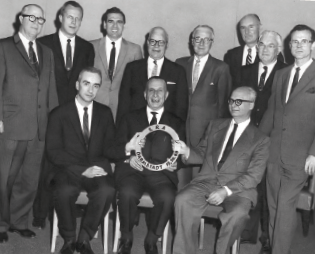
ERA conference in Darmstadt in October 1960: the president with the ERA’s “lifebuoy for the gravure industry”. (Source: GRA)
The case illustrates the close relationship between regulation and production technology. To represent the gravure industry’s interests, a trade association must consider exposure scenarios and potential alternatives alongside investment cycles and legal implications.
Max Rid, a board member representing Heliograph Holding, highlights this connection: “The GRA provides a platform for networking with industry colleagues and discussing ways to lead gravure printing into a successful future. The GRA keeps us informed about regulatory challenges affecting gravure packaging and production.”
Standards rather than individual solutions
The GRA participates in international standardisation bodies and regularly publishes information on ISO standards jointly with Fogra. Current projects include ISO 12647-10 for packaging gravure printing. The new part of the standard is intended to harmonise data exchange and define how colorimetric targets for process and spot colours are specified. Clearly defined responsibilities, targets and tolerances are intended to facilitate coordination between brand owners, prepress providers, cylinder manufacturers and printers.
David Möller, CEO of 4Packaging, says: “For me, GRA membership means shaping the future of gravure printing together – setting standards, driving innovation and showing brand owners that gravure is ready for the next decade.”
In 2026, the GRA also completed a study of the product carbon footprint of different print applications. Leipzig University of Applied Sciences (HTWK Leipzig) compared gravure, flexographic, offset and digital printing for flexible film packaging, publication printing and decorative paper. The study found no across-the-board advantage for any particular process. Instead, it identified material selection, ink application, standardisation and efficiency as the decisive factors. Credible industry representation requires robust data of this kind, rather than simply emphasising the strengths of its own process.
From Europe to a global organisation
The ERA had members outside Europe before its name change, but Europe remained the reference point for its structures. Under its then president, Davide Garavaglia, it began expanding documentation, training and partnerships in new markets in 2023. The change of name to GRA followed in 2025. Revised statutes enabled online meetings and broader participation across time zones.
Rudi Weis-Schiff, Director Business Development at Janoschka Holding, puts the move into perspective from a member’s standpoint: “The GRA’s move towards globalisation creates additional value for members. Its global focus expands the network and provides deeper insights into regional characteristics and market dynamics.”
1962: At the ERA conference in Oslo, Karl Metash of the Gravure Research Institute in the USA and Dr Walter Matuschke of the ERA humorously sealed the “marriage” of the two associations’ interests. (Source: GRA)
Ryota Morisaki, Executive Officer at Think Laboratory, describes how this changes the understanding of competition: “For us, joining the GRA means going beyond our knowledge of gravure printing in Japan gained through our own field of activity. Global expansion is about a forum in which industry colleagues exchange ideas as partners rather than rivals and work together to make gravure the leading printing process. Going forward, the key is to advance global expansion together rather than act alone.”
The new name was also reflected in the association’s leadership in 2025. In Istanbul, members elected Simon Sonn of 4Packaging Africa as president. Kaku Kohli became the first representative from India to be elected to the board, and Mandy Wang the first from China. The current membership list comprises 78 companies, including businesses from China, India, Japan, Taiwan, and North and South America.
The membership spans printers and cylinder manufacturers, suppliers of machinery, inks and substrates, and providers of measurement, software, drying and environmental technologies. This changes the perspective: the association’s work must reconcile differing investment conditions, regulatory frameworks, skills levels and growth trajectories. That task extends far beyond Europe.
Open to other printing processes
The GRA represents gravure printing, but its future does not depend on disregarding other processes. Many packaging printers and suppliers also work with flexographic, offset or digital printing technologies.
Borek Pavlata, Sales Manager at roller manufacturer Ligum, addresses this reality directly: “Our main business is flexographic printing. But we also want to succeed in gravure, which is why GRA membership is very important to us. It offers the opportunity to learn a great deal about gravure and meet interesting people in this business who could become customers.”
His comments point to the criteria by which a trade association’s relevance can be judged after 70 years: its ability to make knowledge accessible, bring interests together and organise technical debate in a way that supports sound decisions. This applies to standardisation as much as to alternatives to chromium trioxide, the circular economy, automation, AI and skills development.
The GRA will celebrate its anniversary at the International Gravure Days in Munich from 7 to 9 October 2026. The location reflects its European roots, while its current membership reflects its wider reach. The most important continuity lies not in the name, but in the idea that a capital-intensive process with closely interdependent technical stages needs a shared infrastructure for exchange, research, standardisation and industry representation.