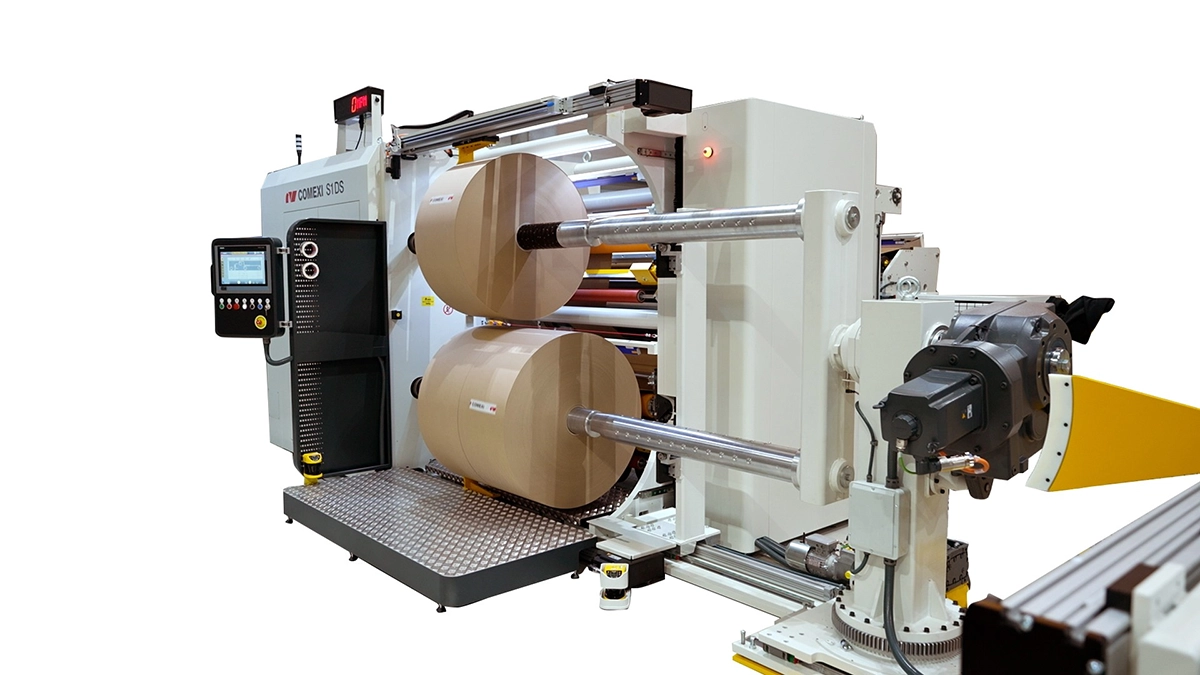
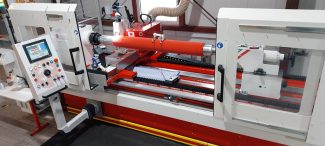
The slitter rewinder is at the heart of flexible packaging converting. For decades, however, converters faced what appeared to be an unavoidable trade-off: they could choose either the highest possible winding quality or maximum productivity. The machine concepts available on the market made it virtually impossible to achieve both objectives to the same standard.
But what if this trade-off could be eliminated entirely?
A look at the development of winding technology shows how the two established winding methods have evolved—and why modern technologies are now opening up new possibilities.
Centre Winding—the Industry Standard
In centre winding, only the winding shaft is driven. The lay-on roll, also referred to as the contact roll, rotates passively and has no drive of its own. Owing to its relatively simple design, this technology has become the standard solution for converting flexible packaging materials.
Its key advantages include a high degree of flexibility, straightforward operation, and comparatively low investment and maintenance costs. Centre winding can also be integrated into both duplex and turret slitter rewinders, making it particularly suitable for high-throughput production environments.
However, the process has inherent limitations in terms of winding quality. Because the lay-on roll operates passively, the reel can deform during winding. This may adversely affect the roll profile, particularly when processing sensitive substrates or operating at high production speeds. For converters whose materials are subsequently used in processes such as laminating or form-fill-seal applications, these variations can result in significant quality and process-related issues.
Centre-Surface Winding—the Benchmark for Maximum Winding Quality
Centre-surface winding takes a fundamentally different approach. Both the winding shaft and the lay-on roll are driven and controlled independently. This keeps the winding point—the distance between the slitting section and the winding nip—constant throughout the entire winding process.
The impact on process stability is considerable. The web is continuously supported, while the actively controlled lay-on roll effectively prevents reel deformation. The result is a more uniform roll profile, tighter tolerances and more consistent performance in downstream converting processes.
For these reasons, centre-surface winding has long been regarded as the benchmark for maximum winding quality. Precise web-tension control is particularly essential when processing high-barrier laminates, metallised films, thin mono-material structures and other tension-sensitive substrates.
Traditionally, however, these quality advantages came at the expense of productivity. Roll changes were generally considered slower than on centre-winding systems. In high-output production environments, where every minute of machine availability matters, this productivity disadvantage proved decisive for many converters. Despite the recognised quality benefits, they continued to select centre winding and accepted the associated compromise.
Why This Compromise Is No Longer Appropriate
The requirements of the flexible packaging industry have changed fundamentally in recent years. Thinner films, recyclable mono-material structures and complex multilayer laminates place significantly greater demands on winding accuracy and web-tension control. At the same time, brand owners and downstream processors are imposing increasingly stringent requirements on roll consistency, slit-edge quality and dimensional accuracy.
A slitter rewinder that offers high production speeds but fails to deliver consistent winding quality can generate hidden costs throughout the entire value chain. Rolls with uneven tension profiles may cause print-register deviations, sealing problems on packaging lines or material losses during laminating. The resulting costs of waste, rework and customer complaints can easily outweigh the apparent productivity gain.
The key question is therefore no longer which winding method has the fewer disadvantages, but whether the technology available today can combine the highest winding quality with maximum productivity.
Advanced Linear Winding System—a New Approach
Drawing on many years of practical experience, Comexi has developed the Advanced Linear Winding System, or ALWS. The system reproduces the operating principles and benefits of centre-surface winding while eliminating the productivity limitations traditionally associated with this technology.
ALWS maintains a constant winding point and provides continuous support through an actively controlled lay-on roll—the defining characteristics of centre-surface winding. At the same time, it enables roll-change cycles and production outputs comparable with those of the most advanced centre-winding systems.
For production managers and machine operators, this delivers a number of tangible benefits:
- Reduced waste through uniform roll profiles. Reel deformation and tension variations that could cause quality problems in downstream processes are significantly reduced.
- Greater repeatability across shifts and operators. Automated control minimises operator-dependent variations and ensures consistently high quality.
- High flexibility through use in both duplex and turret machines. The machine configuration can therefore be adapted to different production requirements without compromising winding quality.
- Production speeds comparable with the highest-performing systems on the market. Centre-surface-level winding quality therefore becomes economically viable even in production environments with the most demanding throughput requirements.
Implications for Flexible Packaging Converters
The growing use of thinner and more demanding substrates—driven by sustainability requirements and the shift towards recyclable mono-materials—makes precise winding technology more important than ever. Materials that only a few years ago could tolerate minor tension variations are now considerably more sensitive to even the smallest irregularities.
At the same time, economic pressure to increase production throughput remains unchanged. What converters need, therefore, are machine concepts that enable high productivity without generating hidden costs elsewhere in the process chain as a result of quality defects.
The Advanced Linear Winding System offers a new approach to meeting these requirements. It overcomes the historic trade-off between winding quality and productivity, enabling converters to combine both objectives on a single technology platform.
Conclusion
The long-standing trade-off between winding quality and production speed is no longer a technical necessity. Advances in winding technology now make it possible to achieve the winding quality of a centre-surface system at production speeds comparable with those of the highest-performing centre-winding machines.
For converters considering a new investment, this fundamentally changes the basis for decision-making. The focus is no longer on identifying an acceptable compromise, but on selecting a technology capable of delivering both quality and productivity without sacrificing either.