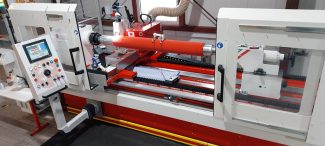
Q-Trac Chrome Aims to Replace Conventional Press Proofing
von Ansgar Wessendorf,
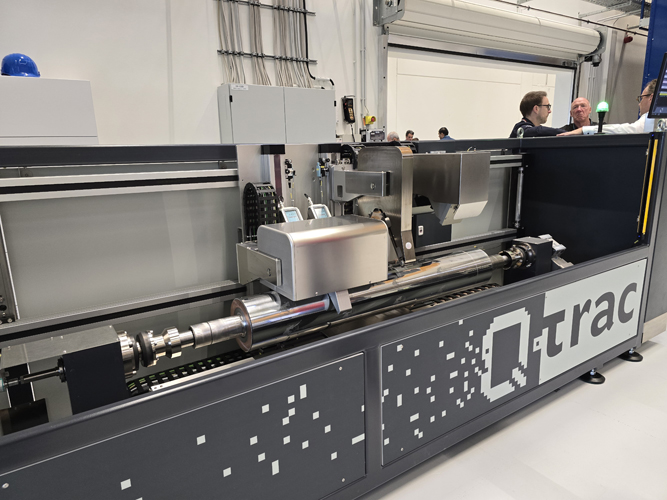
The data provided by Q-Trac Chrome enables specialists to inspect the cylinder’s chrome surface in detail at the Digital Proof Station and subsequently approve it within a fully digital workflow
The official market launch of Kaspar Walter’s Q-Trac Chrome with Digital Proof Station marks a development that fundamentally redefines quality control in fully automated gravure cylinder production.
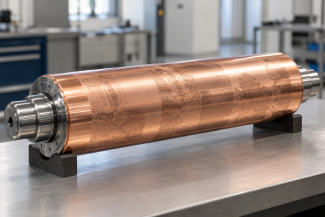
Instead of relying on a complex and costly physical press proof, Q-Trac Chrome captures all quality-relevant characteristics of the finished chrome-plated cylinder. Its high-resolution analysis enables specialists to examine the cylinder surface in detail at the Digital Proof Station and approve the cylinder entirely within a digital workflow.
Anzeige
The system has been developed specifically to meet the requirements of modern cylinder production. It automates the acquisition of key quality parameters, including geometry, surface roughness and the engraved print image. This generates consistent, reproducible and accurate measurement results, independent of manual measuring procedures and individual operator influence.
A further advantage is the automated calibration of the measuring systems. Q-Trac Chrome ensures regular and precise calibration without operator intervention, thereby improving the comparability and reliability of the quality data. Using intelligent algorithms, the system analyses the chrome surface and selectively identifies deviations that are relevant to the production process.
The acquired measurement data is available in real time, enabling immediate analysis and rapid decision-making during production. Q-Trac Chrome therefore provides the basis for end-to-end digital quality control and greater process reliability in gravure cylinder manufacturing.
Eliminating the conventional press proof not only makes quality inspection more efficient, but also improves process traceability, reduces proofing costs and shortens production cycles. Depending on the size of the surface to be inspected, a complete quality check of a chrome-plated cylinder takes just 10 to 18 minutes.
Analogue Quality Control Is Reaching Its Limits
Many quality-control processes in gravure cylinder production still rely on analogue inspection methods. A variety of measuring instruments, often without standardised procedures, are used, and the results can depend heavily on the experience and accuracy of the individual operator. This may lead to variations in measurement results and compromise process reliability.
The manual transfer of measurement data to higher-level systems also prevents seamless use of the information. Quality data is frequently not available immediately, making rapid decisions and targeted process optimisation more difficult. Surface defects are often detected only during the final proofing stage, by which time considerable resources have already been invested in producing the cylinder.
Until now, the conventional press proof has been an essential step in reliably identifying defects in cylinder geometry, surface quality and engraving, and in preventing defective cylinders from being delivered. However, because this inspection takes place at the end of the production chain, deviations often become apparent only at a late stage. Corrective action is consequently delayed and generates additional costs.
Conventional proofing also involves considerable expense. Proof presses, substrates, inks and the additional labour and time required all affect production economics. At the same time, transporting cylinders outside the production line increases the risk of damage.
The measuring technology itself presents further challenges. Irregular calibration intervals and dependence on operator experience can impair both the quality and comparability of the measurement data.
Already in Production Use
With Q-Trac Chrome, Kaspar Walter is setting new standards for transparency, process reliability and cost efficiency in modern gravure cylinder production. The solution paves the way for fully digital quality control and helps cylinder manufacturers and packaging printers make their production processes more efficient, faster and more sustainable.
The technology is already being used in industrial production. Several Q-Trac Chrome systems have been installed at cylinder manufacturers and packaging printing companies, where they are optimising quality inspection within their production processes.