How a carbon-fibre-reinforced polymer load-bearing tube reduces shaft weight sufficiently to keep frequent manual reel changes within occupational ergonomic requirements—without compromising stiffness, concentricity or dynamic performance.
At many unwinding stations in packaging production, reel changes are part of routine operations. Unlike applications in which an expanding shaft is moved only once per shift, these shafts may have to be removed, fitted with a new reel and reinstalled many times a day. Removing the empty core, picking up the full reel, lifting the shaft out of its bearing blocks, reinstalling it and aligning it—every change involves several manual lifting operations.
Under these conditions, what may initially appear to be merely a question of material selection quickly becomes an issue of ergonomics and occupational safety. With every repetition, the physical strain on operators increases. While a steel shaft with a large clamping length and diameter can easily weigh several dozen kilograms, its dead weight ultimately determines whether a workstation can be operated ergonomically over the long term or whether additional lifting equipment is required.
A customer from the packaging industry faced precisely this challenge and approached IBD Wickeltechnik for a solution. The objective was not to save a few grams, but to develop a design that would significantly reduce the shaft’s dead weight without altering the mechanical characteristics of the company’s proven product range.
Ergonomics Starts with the Design—not with the Lifting Device
In Germany, the legal requirements governing the manual handling of loads are defined by the Ordinance on the Handling of Loads, which implements European Directive 90/269/EEC. Contrary to a widespread assumption, there is no universally applicable maximum weight limit. Instead, the legislation requires a risk assessment that considers the load weight, posture, gripping conditions, sequence of movement and, in particular, the frequency of lifting operations.
It is precisely this frequency of repetition that makes reel changes at winding stations ergonomically demanding. A load that may appear unproblematic when lifted occasionally can place considerable strain on the lumbar spine when handled several dozen times during a shift.
An established assessment tool is the Key Indicator Method for Lifting, Holding and Carrying developed by the German Federal Institute for Occupational Safety and Health, BAuA. In industrial practice, loads exceeding 25 kg for men or 15 kg for women are frequently used as reference values above which a task should be assessed separately. Significantly lower limits apply to pregnant employees under Germany’s Maternity Protection Act, while the Youth Employment Protection Act also restricts physically demanding work according to the individual’s capacity.
For machinery operators, this has immediate practical implications. The lighter an expanding shaft can be made, the larger the group of employees able to operate the machine without additional lifting aids.
Aluminium Reduces Weight—CFK Resolves the Design Conflict
The obvious first step towards reducing weight is to use an aluminium load-bearing tube. For this reason, aluminium expanding shafts have long formed part of the standard portfolio of high-quality winding technology suppliers.
At large clamping lengths, however, aluminium reaches its physical limits. To minimise deflection under a heavy reel, the tube must provide sufficient stiffness. Achieving this stiffness requires greater wall thicknesses—which, in turn, increase the weight. The result is a classic design conflict between flexural rigidity and mass.
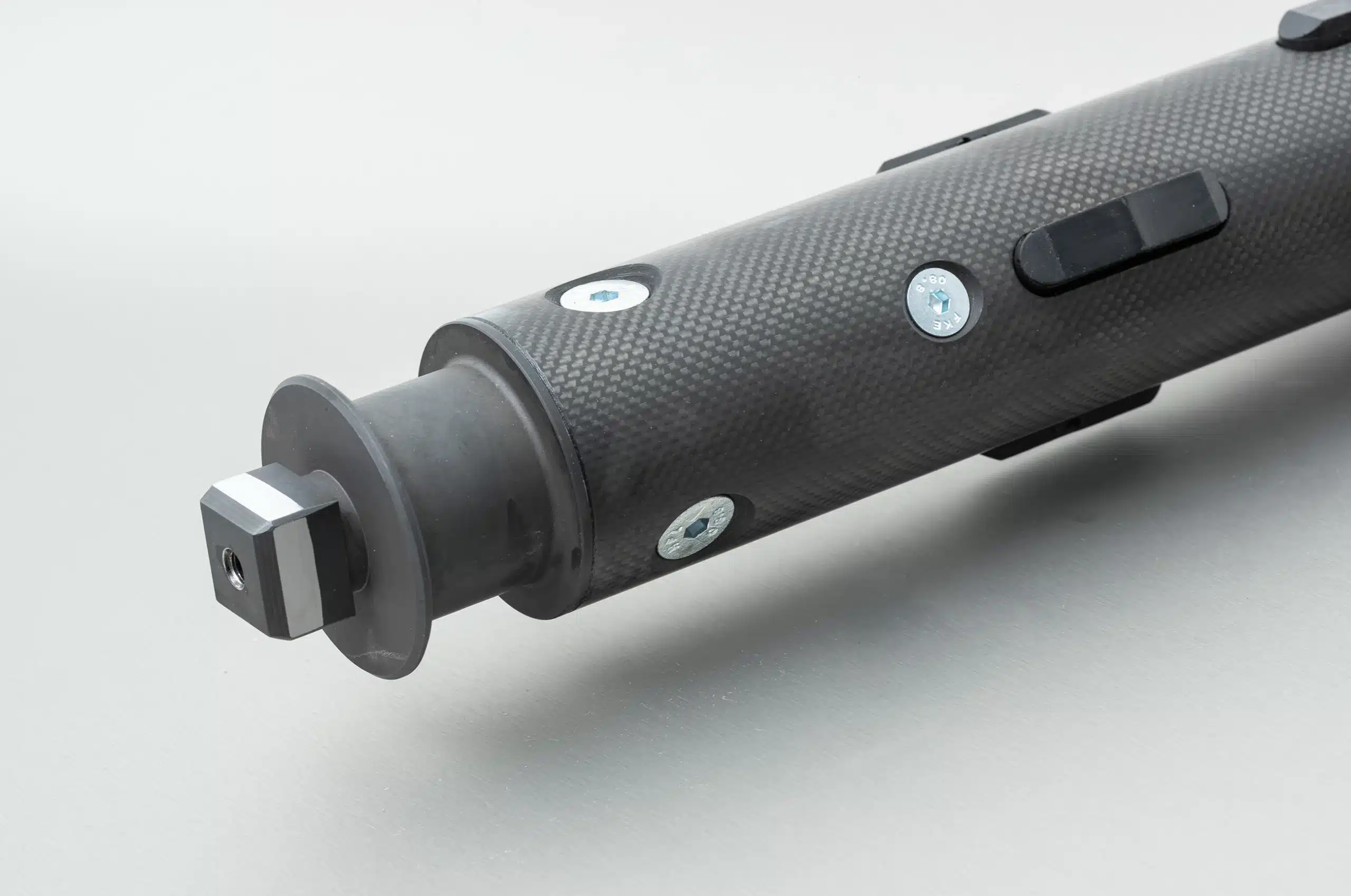
This is where carbon-fibre-reinforced polymer, or CFK , opens up new design possibilities. Its decisive advantage is its exceptionally high specific stiffness—the ratio between elastic modulus and density. At a significantly lower weight, CFRP can provide flexural rigidity comparable to or even greater than that of aluminium or steel.
In the custom solution developed by IBD Wickeltechnik, only the load-bearing tube was therefore replaced with a CFK component. All highly loaded functional components—including the bearing journals, mounting journals, clamping mechanism, expanding elements and inflation valve—remain unchanged, are manufactured from steel and are taken from the proven modular system of the PSW-Z expanding-shaft series.
This division of functions follows a clear design rationale. While most of the shaft’s mass is distributed along the clamping length within the load-bearing tube, the end components must transmit high bearing, clamping and drive forces. Owing to its strength and fatigue resistance, steel remains the appropriate material for these components. At the same time, spare-parts availability, maintenance procedures and the overall service concept remain fully compatible with the standard product series.
Approximately 20 PerCent Lighter than Aluminium
The weight advantage is greater than many users might expect.
For a 3-inch expanding shaft with a diameter of 76 mm and a clamping length of two metres, the CFK load-bearing tube reduces the shaft’s total weight by approximately 20 percent compared with an aluminium version and by around 60 percent compared with a steel shaft.
What is particularly significant is not the expected difference compared with steel, but the additional weight saving achieved over an already weight-optimised aluminium design. In many applications, it is precisely this reduction of around 20 percent that determines whether an expanding shaft remains permanently within the defined ergonomic target range or whether additional organisational or technical measures are required.
Material Benefits Extending Far Beyond Weight Reduction
The comparatively high cost of CFK does not make it a universal solution. It becomes economically attractive wherever its mechanical properties deliver a direct improvement in machine operation.
Its greater flexural rigidity reduces shaft deflection under load. This helps maintain more uniform web tension across the full working width and can improve both winding quality and web guidance, particularly when processing large reels.
The shaft’s critical speed also increases. As resonance behaviour is directly influenced by stiffness and mass, the lighter load-bearing tube permits higher web speeds while simultaneously ensuring smoother running characteristics.
CFK also provides greater inherent material damping than metallic structures. Vibrations decay considerably faster, reducing the load on the bearings and helping to improve the surface quality of sensitive webs.
A further advantage is the lower mass moment of inertia. The reduction in rotating mass shortens acceleration and braking cycles, decreases the drive torque required and makes it easier to rotate the shaft manually during machine set-up.
CFK also offers benefits in terms of thermal behaviour. Its low coefficient of thermal expansion helps preserve concentricity and geometric stability even when temperatures fluctuate—an important consideration wherever tight web-guidance tolerances must be maintained.
It is the interaction of all these properties that creates the solution’s real added value. The expanding shaft is not merely lighter; it is also stiffer, less susceptible to vibration and more favourable in terms of dynamic behaviour. This extends the process operating window of the entire winding station.
“CFK is not an end in itself, nor is it the right answer for every shaft. In this case, the requirement was clearly defined: frequent reel changes, handling by one person and a strict weight target. Aluminium had reached its limits, and that is precisely where a carbon-fibre load-bearing tube demonstrates its strength. We retain our proven modular system for clamping and bearing components and change the material only where it makes the decisive difference,” explains Holger Brink, Managing Director and Technical Director of IBD Wickeltechnik.
Application-Specific Shaft Design Rather than an Off-the-Shelf Solution
The main development challenge, however, lay less in selecting the material than in engineering the expanding shaft. Winding shafts are not universal catalogue products. The clamping length, core diameter, load capacity, rotational speed, drive interface, ambient conditions and target handling weight combine to form an individual specification for every application.
The modular design of IBD’s shaft ranges allows the material of the load-bearing tube, expanding elements, bearing journals and other components to be adapted to the specific application without abandoning the proven clamping principle or ease of maintenance. While changing the tube material to CFK provided the decisive leverage in this project, other applications may place greater emphasis on adjustable clamping mechanisms, specially adapted expanding elements or dedicated bearing concepts.
The design is therefore consistently based on the machine’s actual requirement profile rather than on modifying a standard product as far as possible.
A Transferable Concept for Weight-Critical Changeover Stations
The solution developed is not limited to this particular packaging application. Wherever expanding shafts are changed manually on a regular basis and their dead weight becomes an ergonomic bottleneck, a CFK load-bearing tube can offer considerable potential.
Whether used on unwinders, rewinders, coating lines or printing presses, the selective use of CFK an meet ergonomic requirements wherever high stiffness, precise concentricity and low weight are required simultaneously—without compromising functionality, dynamic performance or serviceability.
Application-specific engineering nevertheless remains essential. The performance of an expanding shaft is not determined by the material alone, but by the careful design and coordination of all components in relation to the process concerned.