Schönwald Study Puts the 2025 Market at More Than 4.2 Million Tonnes
von Ansgar Wessendorf,
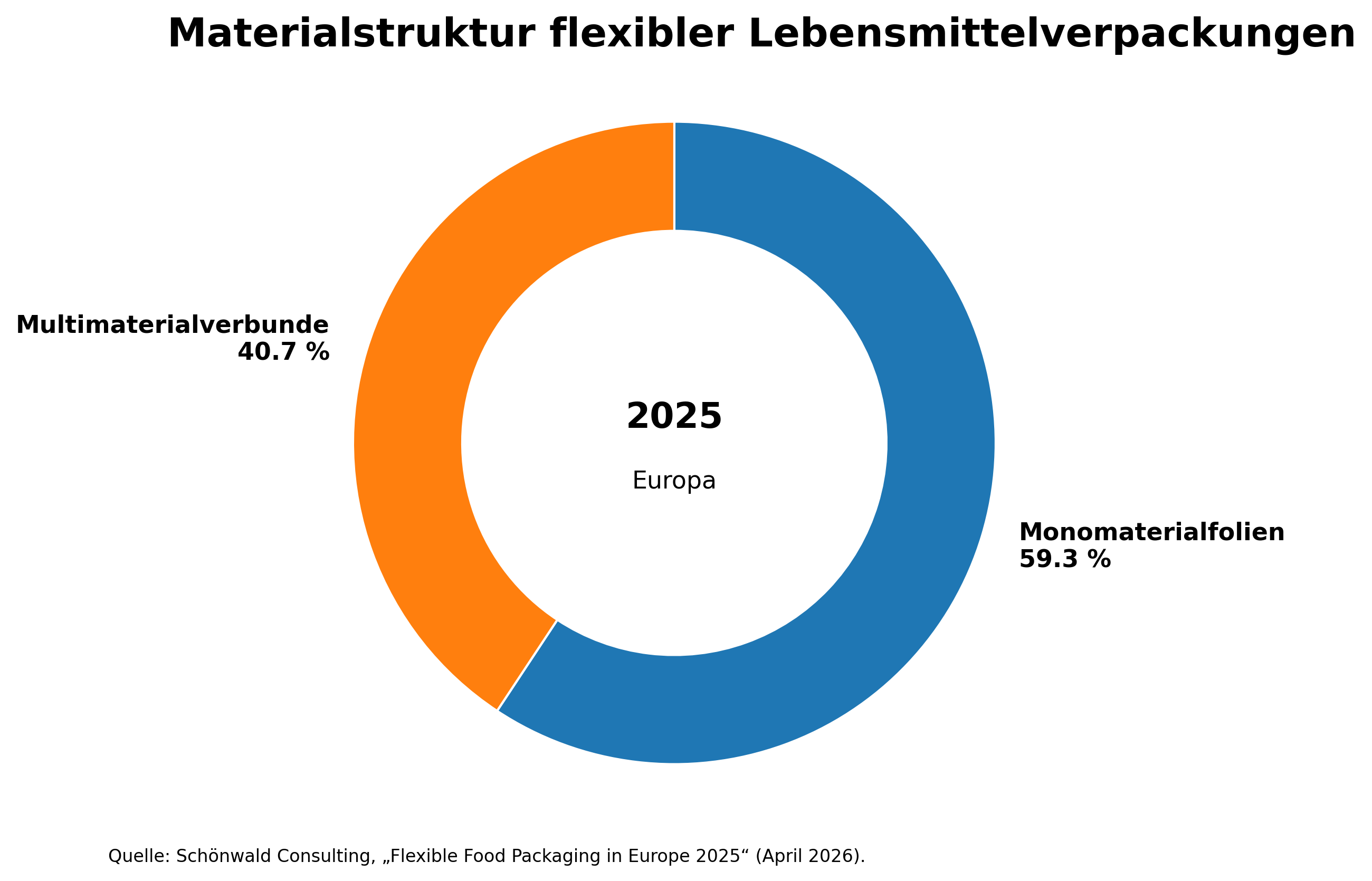
Shares of mono-material and multi-material structures in European flexible food packaging in 2025 (Source: Schönwald Consulting, “Flexible Food Packaging in Europe 2025”)
The European market for flexible food packaging continues to grow. According to the latest “Flexible Food Packaging in Europe” study by Schönwald Consulting, consumption exceeded 4.2 million tonnes in 2025. The study also highlights a marked shift in material structures: OPP remains the leading substrate family, paper-based solutions are gaining ground, and mono-material films now account for the majority of the market.
A market study with a broad analytical scope
Published in April 2026, the Schönwald Consulting study provides a detailed assessment of the European market for flexible food packaging. Across 140 pages, it analyses 2025 consumption in eleven application segments and seven material groups. The report contains 88 tables and charts and also addresses the regulatory and technological forces shaping the market through 2030.
Anzeige
Its central finding is clear: European consumption of flexible food packaging rose to more than 4.2 million tonnes in 2025. The market therefore remains one of the most important volume arenas for film producers, printers, laminators and converters. At the same time, the underlying material mix is changing as recyclability, fibre-based alternatives and mono-material design move closer to the centre of commercial decision-making.
Three segments account for more than half of demand
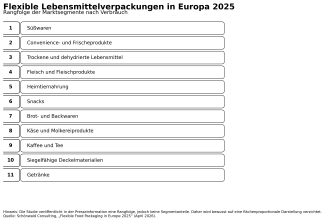
The study ranks confectionery as the largest application segment, followed by convenience foods and fresh products, and dry and dehydrated foods. Together, these three categories account for more than half of total European consumption.
They are followed by meat and meat products, pet food, snacks, bread and bakery products, cheese and dairy products, coffee and tea, sealable lidding materials, and beverages.
The ranking shows how strongly flexible packaging is anchored in high-volume food categories. These applications combine fast packaging speeds, extensive retail distribution and demanding product-protection requirements. For converters, the concentration of demand in a small number of large segments creates dependable volumes, but it also accelerates the spread of new material specifications once major brand owners or retailers adopt them.
OPP retains the leading position
Schönwald Consulting divides the market into PET-, PA-, OPP-, PP- and PE-based films, paper-based flexible packaging, and flexible aluminium foil. Within this framework, OPP-based structures remained the largest material group in 2025.
The position of OPP reflects its established combination of stiffness, transparency, printability and relatively low weight. It is also supported by a mature European processing infrastructure for printing, coating, metallising, laminating and pouch production.
The most notable structural change is the rise of paper-based solutions. Their consumption increased further over the period covered by the study, placing them second behind OPP-based films in 2025. OPP and paper-based flexible packaging together represented more than half of the material structures used and were both present in the three largest application segments.
This finding suggests that paper-based flexible packaging is moving beyond niche launches and limited marketing applications. However, it should not be interpreted as a simple one-for-one replacement of plastic film. Many paper-based packs still require functional coatings, sealable layers or thin barriers to protect against moisture, grease, oxygen and aroma loss. The development challenge lies in combining these functions with efficient converting and a credible recycling route.
Mono-material films approach a 60% share
A further key result concerns the balance between mono- and multi-material structures. Mono-material films accounted for 59.3% of the market in 2025, while multi-material structures still represented 40.7%.
Mono-material designs have therefore become the majority, but conventional laminates remain indispensable in a substantial part of the market. Their continued importance is closely linked to demanding barrier and mechanical requirements. Meat, cheese, coffee, pet food and other sensitive products often require combinations of oxygen barrier, moisture protection, puncture resistance, light protection, printability and reliable sealing performance.
The figures highlight a central tension in current packaging development: improved recyclability must be achieved without compromising product protection or packaging-line performance. Reducing the number of material families does not necessarily make a pack technically simpler. In many cases, it increases the demands placed on film formulations, coatings, primers, inks, adhesives and high-barrier layers.
Seven material groups reflect a diversified market
The study’s seven material categories underline the technological diversity of flexible food packaging. Beyond the two leading groups, PET-, PA-, PP- and PE-based films as well as aluminium foil continue to serve distinct performance profiles.
PET remains relevant where dimensional stability, heat resistance and print performance are essential. PA-based structures are important for applications requiring toughness and puncture resistance. PE- and PP-based systems are becoming strategically more significant as the industry develops recycling-oriented mono-material families. Flexible aluminium foil continues to offer exceptionally high barriers against light, oxygen and moisture.
The value of the study lies partly in connecting these material systems with specific end-use segments. It avoids the assumption that the market is moving towards one universal substrate. The requirements of confectionery, meat, cheese or coffee differ too widely for a single solution to dominate all applications.
Growth rates to 2030 provide a strategic perspective
In addition to the 2025 market volumes, the study assesses the future development of individual segments through average annual growth rates to 2030.
For decision-makers, this distinction is important. Current consumption identifies where the largest volumes are processed today; projected growth indicates where new capacity, specialised converting technology and material innovation may be required in the coming years.
A comparatively small application can therefore be strategically attractive if its growth rate exceeds that of a mature high-volume segment. Combining segment size, material structure and growth outlook provides a more useful basis for investments in printing, coating, lamination, extrusion and testing equipment than market volume alone.
The PPWR forms a second major focus
The study does not limit itself to market volumes and substrate structures. A substantial section is devoted to the European regulatory framework for sustainable packaging, with particular attention to the Packaging and Packaging Waste Regulation, or PPWR.
Schönwald Consulting explains relevant articles as well as the associated delegated and implementing acts. The report also includes a timeline of regulatory measures, transition periods and key deadlines. According to the study’s press information, it takes account of guidance on the PPWR published by the European Commission on 30 March 2026.
This regulatory dimension is central to understanding the market outlook. Flexible packaging will increasingly be assessed not only by price, material efficiency and functionality, but also by recyclability, recycled-content requirements, documentation and compatibility with collection and recycling systems.
The need for robust material data will consequently increase. Inks, coatings, adhesives, barrier layers and closures will have to be evaluated as parts of a complete packaging system rather than as isolated components.
Ranking of market segments for flexible food packaging in Europe in 2025. (Source: Schönwald Consulting, “Flexible Food Packaging in Europe 2025”)
Recyclates, bio-based plastics and fibre solutions
The study also addresses four technology fields that are likely to influence the next phase of market development: plastic mono-materials, fibre-based solutions, bio-based plastics and recyclates.
These approaches pursue different objectives and should not be treated as interchangeable. Mono-materials are primarily intended to improve sortability and recycling. Fibre-based solutions often aim to increase the share of renewable feedstock and make use of established paper-recycling streams. Bio-based plastics concern the origin of the raw material, while recyclates focus on returning previously used material to production.
None of these categories guarantees circularity on its own. A bio-based film is not automatically recyclable; a paper-based pack may still contain functional polymer layers; and a technically recyclable mono-material structure can remain ineffective where collection and sorting infrastructure is insufficient. By considering these technologies alongside regulation and market data, the study provides a more realistic picture of the transition.
Implications for printers and converters
Several conclusions can be drawn for the printing and converting industry.
First, large-volume segments such as confectionery, convenience products and dry foods remain the economic backbone of the market. Suppliers serving these applications can expect substantial demand, but also rapid changes in specifications.
Second, the ability to process a wider range of substrates is becoming more important. OPP remains dominant, while paper-based structures are gaining commercial relevance. Printers and converters must therefore handle both conventional polymer films and more sensitive coated fibre substrates with consistent print quality and production efficiency.
Third, the high mono-material share is changing technology requirements. Ink, adhesive and coating systems increasingly need to support recycling-oriented PE or PP structures. At the same time, the 40.7% share of multi-material structures demonstrates that there remains a large market for high-performance laminates.
Fourth, documentation is becoming part of the product. Converters will increasingly be expected to supply not only a technically functional pack, but also reliable information on its material composition and regulatory suitability.
The converter’s role is therefore expanding. Rather than acting solely as a producer of printed and laminated webs, the company becomes a development partner that must reconcile packaging performance, production efficiency, recyclability and regulatory compliance.
A market defined by growth and transformation
The Schönwald study delivers a twofold message. European consumption of flexible food packaging is still growing and exceeded 4.2 million tonnes in 2025. At the same time, the internal structure of the market is changing significantly.
OPP retains first place, paper-based solutions have moved into second position, and mono-material films account for almost 60% of consumption. Nevertheless, multi-material structures continue to represent 40.7% and remain essential in many technically demanding applications.
The market is therefore not converging on a single dominant material. Instead, it is developing into a more differentiated portfolio in which application requirements, barrier performance, machinability, recyclability and regulation must be balanced case by case.
For printers and converters, this creates both pressure and opportunity. The coming years are likely to be shaped less by sweeping material substitution than by the ability to develop robust packaging systems that are technically reliable and better aligned with Europe’s emerging regulatory framework. Schönwald Consulting’s “Flexible Food Packaging in Europe” study provides an extensive quantitative and qualitative foundation for those decisions.