Less Ink, Shorter Make-Ready Times: Bobst Advances Gravure Printing
von Ansgar Wessendorf,
“The international gravure printing market continues to grow, despite the pressure from market trends and competing printing technologies. Industry reports, including those from Smithers Pira, confirm this.”
– Davide Rossello, Process R&D Manager Gravure at Bobst –
(Source: Bobst)
How can gravure printing remain economically viable as print runs become shorter? For packaging printers, this question brings not only printing performance but also material consumption, job changeover times and operator workload into focus. A key factor is how efficiently the processes before and after printing can be organised – from ink supply to cleaning the gravure cylinders.
Bobst is addressing these challenges with the further development of its MASTER 6003 gravure printing platform. At the heart of these improvements is the LeanPrint ink system. According to the manufacturer, it reduces the amount of ink required in the ink circuit by 60% compared with the previous configuration, while solvent consumption is reduced by up to 40%. Additional developments include automated pre-cleaning of gravure cylinders and improvements to ink container handling. These are designed to speed up job changeovers and reduce operator workload. Integrated measuring functions also provide transparency on ink, electricity and compressed air consumption during production.
Anzeige
This raises an important question for printers: How do ink supply, automation and consumption monitoring work together to improve the overall efficiency of the gravure printing process?
In an interview with VerpackungsDruck & Converting, Davide Rossello, Process R&D Manager Gravure at Bobst, explains the technical approaches behind these developments and their implications for the economic efficiency of packaging production.
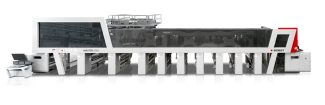
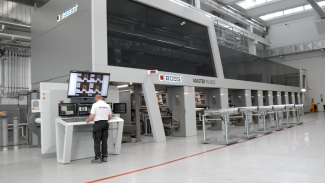
Bobst’s MASTER RS 6003 gravure printing press combines an optimised ink supply system with automated cleaning functions and integrated consumption monitoring (Source: Bobst)
How is the international packaging gravure market currently developing? In which regions and applications are printers investing in new capacity, and where is the focus primarily on modernising existing equipment?
Davide Rossello: The international gravure market continues to grow, despite the pressure from market trends and competing printing technologies. Industry reports, including those from Smithers Pira, confirm this. The traditional gravure markets are still growing. In Europe, growth in the gravure market is relatively modest, but it is growing nonetheless. However, Asia remains the main driver of growth.
In many cases, investments involve replacing one or two older presses with a new high-performance machine. However, we also have customers who are upgrading their existing equipment with retrofit solutions. We offer various solutions for this purpose, some of which can significantly improve press performance and efficiency within a relatively short time.
At the same time, these companies are investing in new presses to expand their production capacity and meet today’s increasingly demanding market requirements – thanks to higher production speeds, greater flexibility, consistently high print quality and fewer manual interventions.
Shorter print runs and more frequent design changes are affecting the economics of packaging printing. Under what conditions does gravure remain competitive compared with flexographic and digital printing? And where do you see its limitations?
Davide Rossello: That’s a very interesting question. These trends are not new to the printing industry. In fact, they play a central role in decisions about which printing technology to use.
I believe many printers assume that switching from gravure to flexographic printing could be the solution for their business – although that is not always the case.
Let’s take short print runs for limited-time promotional campaigns as an example. In these cases, flexographic printing may be the better choice. However, the situation is different for recurring short runs, such as packaging for less popular flavours. Although these are produced in small quantities, they are required over a long period. In such cases, gravure printing is by far the better solution. Print quality remains consistently high, excellent and reproducible over many years because gravure cylinders do not wear out during these repeat jobs.
Furthermore, gravure printing offers additional ways to address the challenges potentially associated with shorter print runs. For example, Bobst’s oneECG fixed-colour-gamut printing solution enables different jobs to be printed using the same set of cylinders. At the same time, it can reduce make-ready times during job changeovers by up to 60%.
With oneECG, consistent print quality can also be guaranteed in gravure printing – from the digital proof to the first printed sheet. We recently demonstrated this at our Open House using real examples from packaging manufacturers and brand owners, where visitors were able to compare digital proofs directly with the results achieved in gravure printing. They were surprised and genuinely enthusiastic. As the saying goes, seeing is believing.
All of this makes it possible to achieve premium print results while reducing waste and shortening make-ready times. In many applications, fewer sets of cylinders are also required. Ultimately, this not only enables greater production efficiency but also significantly improves profitability.
Material reduction and recyclability are changing packaging requirements. What are the implications for gravure printing on thinner films, mono-materials and paper? And which technical challenges still need to be addressed?
Davide Rossello: This is currently one of the hottest topics in the industry. It is clear that we need to handle these new materials in a completely different way. We cannot simply assume that they can be printed and converted in the same way as the materials we have worked with in the past. This aspect is often underestimated.
Because we work closely with industry partners, packaging manufacturers and brand owners at our Competence Centres, we gain early insights into the complexities associated with new materials. And we know that challenges always present opportunities.
Through barrier testing at our Competence Centres, we can identify at an early stage how new materials and material structures behave on our printing presses. This gives us a deeper understanding of the processes involved. It is a crucial factor because it allows us to develop and bring new technologies and innovations to market in a targeted way. This is an ongoing process in which we have already made significant progress. However, there is still a great deal of work ahead of us.
In addition, we have developed Register+, a solution for next-generation materials that automatically compensates for quality deviations in roll-to-roll processes, particularly when handling demanding substrates such as PE and paper.
Another example is our Twin-Flow dryer, which enables drying at lower temperatures thanks to its extremely high efficiency. This improves web handling and register accuracy, particularly with heat-sensitive materials such as PE.
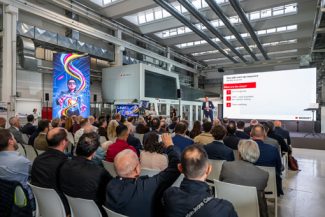
Bobst presented the further developed MASTER RS 6003 gravure printing press to a wider audience of industry professionals for the first time in mid-October at its Competence Centre in San Giorgio Monferrato, Italy. (Source: Bobst)
According to Bobst, the MASTER 6003 requires 60% less ink in the ink circuit and reduces solvent consumption by up to 40%. What was the basis for these comparisons, and under which production conditions were these figures determined? What proportion of the savings is achieved during printing itself, and how much during cleaning and job changeovers?
Davide Rossello: The savings are based on calculations performed using our ROI (Return on Investment) simulator. The underlying data comes from actual operating and production figures provided by our customers.
We used the simulator live during the event, running various scenarios to illustrate how different parameters affect savings and ROI.
The data takes into account fundamental aspects of the printing process, including average print run lengths, the average quantities of ink that can be reused after completing a print job, and the quantities of ink that have to be disposed of. For these calculations, we considered only spot colours as an example.
Furthermore, we deliberately used very conservative assumptions in our calculations to avoid making unrealistic promises. This means that we expect even better results to be achievable in practice.
It is also important to compare like with like. For example, the quantities of ink contained in the ink tanks should not be confused with the total quantities of ink required to complete print jobs.
The potential savings in inks and solvents are attributable to the new ink system and innovations incorporated into our LeanPrint solution. Other innovations we have presented, such as the automatic cleaning of the engraved cells on gravure cylinders, accelerate job changeovers and therefore offer additional opportunities to increase productivity.
Ultimately, all these improvements benefit the bottom line. By enabling economical production of premium-quality printed products, they reduce operating costs and thus contribute to higher profitability.
In practice, how much time can be saved through automated cylinder cleaning and simplified handling during job changeovers compared with the previous configuration? And which operations continue to determine make-ready times?
Davide Rossello: With our innovative automated cleaning of engraved gravure cylinders before printing, we are optimising job changeovers in an area that is often overlooked.
Until now, cylinder cleaning was a manual operation that had to be carried out before every print job. Thanks to automation, the time required for this step can be reduced by five minutes to less than one minute.
Translated into additional press operating time, these savings could potentially allow printers to increase their annual production capacity by 2.5 million m², corresponding to potential additional revenue of €540,000.
When does investing in a new MASTER 6003 pay off compared with continuing to operate or upgrading existing gravure presses? What role do job structures, capacity utilisation and consumable costs play? And what reliable operating experience is already available?
Davide Rossello: The return on investment is extremely fast. Our data shows that a direct comparison is hardly possible. Frankly speaking, there is no longer any reason to equip a new MASTER 6003 with a conventional ink system. Without LeanPrint, it simply would not make sense.
The world is confronting us with uncertainties regarding the cost and availability of consumables. Naturally, we have no influence over market prices or market stability.
What we can influence, however, is the efficiency with which materials are processed on our presses. By improving the efficiency of our printing equipment in this way, we reduce its total cost of ownership and thereby increase our customers’ profitability.